
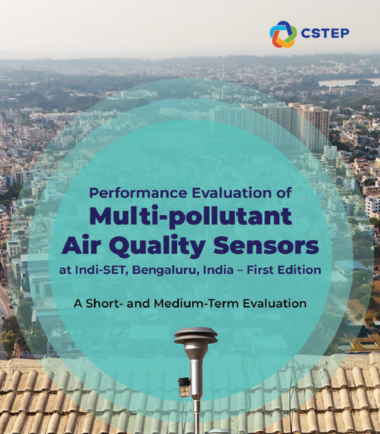
Performance evaluation of multi-pollutant air quality sensors at Indi-SET, Bengaluru, India

Published 23 April 2026

A sensor evaluation study was conducted at the first-of-its-kind facility in India—the India Air Quality Sensor Evaluation and Training (Indi-SET) facility, at CSTEP’s Bengaluru campus—prior to deployment of a multi-pollutant sensor network across urban Bengaluru.

Setting the context

Air quality sensors or low-cost sensors are small, affordable devices used to measure and track pollution levels. However, their readings can be influenced by the nature and composition of polluting particles, weather, and other environmental factors. Because of this, they need to be tested and adjusted before being used widely.


Why was the study done?

Before installing a network of sensors across Bengaluru, the study tested forty-eight devices from six different manufacturers at the India Air Quality Sensor Evaluation Facility at CSTEP, Bengaluru. These sensors measured common pollutants such as particulate matter (PM2.5 and PM10), nitrogen dioxide, ozone, and carbon monoxide.


How did the testing work?

All sensors were placed next to a reference monitor and observed over a short period (about 1–2 months) to check consistency and accuracy and a longer period (about 8 months) to check durability and reliability.


What did the study find?

  1. Sensor readings varied a lot
  • Even when measuring identical concentrations, sensors from different manufacturers produced varying results. Notably, differences were observed even among sensors from the same manufacturer.
  • None of the sensors were consistently accurate for all pollutants when compared with the reference system.
  1. Some pollutants were measured better than others
  • PM measurements were more reliable than those for gases such as nitrogen dioxide and ozone.
  • Carbon monoxide readings were reasonably consistent for some brands.
  1. Performance issues over time
  • Some gas sensors showed faulty behaviour (e.g., fixed or capped readings).
  • Many PM sensors stopped working within 6 months.
  • This shows that sensors can degrade quickly without regular checks.
      

Improving sensor accuracy

To improve data reliability, the study adjusted the sensor readings using local data. These corrections significantly improved performance, especially for gases such as nitrogen dioxide and ozone.


Key recommendations

  • Adjust sensors for local conditions: Each city or region needs its own calibration to get accurate results.
  • Build more testing centres: India needs more facilities to evaluate sensors under different environmental conditions.
  • Check sensors regularly: Devices should be tested every 3–6 months to ensure they are working properly.


Kavyashree N Kalkura (Former Analyst at CSTEP) and Dr R Subramanian (Former Head of Air Quality Sector at CSTEP) co-authored the report.


Click here to read the Press Release

Have a query?

Get in touch with us at

cpe@cstep.in