
Pathways for clean transportation in Punjab

Published 21 August 2026

Why this study matters

Punjab has undertaken several initiatives to improve air quality. This study examines the transport sector as an opportunity for further PM₂.₅ reductions, analysing the state’s vehicle fleet and emissions by vehicle category, district, and Bharat Stage, with a particular focus on super-emitters (SEs) because of their significantly higher emission factors.
 

What the analysis reveals

  • Transport contributes substantially to PMâ‚‚.â‚… levels across Punjab, including districts without NCAP non-attainment cities.
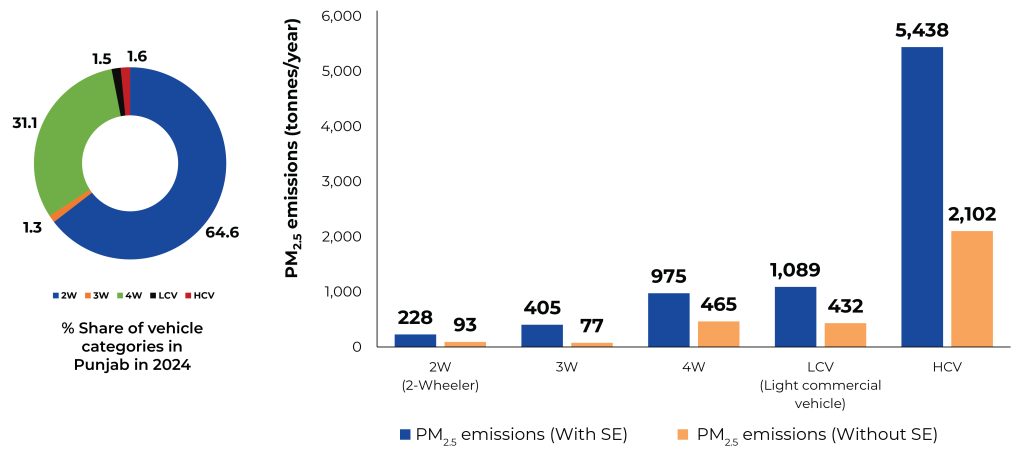
  • Two-wheelers, three-wheelers, and four-wheelers dominate the fleet numerically, but freight vehicles, particularly HCVs, contribute disproportionately to emissions.
  • SEs make up a small share of the fleet but can contribute more than half of PMâ‚‚.â‚… emissions in many districts.
  • Older vehicles, particularly 3Ws, HCVs, and LCVs, continue to operate on Punjab’s roads.
  • 89% of surveyed vehicles were registered in Punjab, while 28% of HCVs were registered outside the state.
  • Significant cross-district vehicle movement suggests that a city-specific approach may not adequately address transport emissions.
  • PMâ‚‚.â‚… emissions could decline by 30%–66% between 2024 and 2035 with increasing uptake of cleaner BS-VI and electric vehicles. However, SEs are expected to remain a major source of emissions.
PM2.5 emissions from different vehicle classes in Punjab using survival fraction

What is holding progress back

  • No formal definition or policy framework for SEs.
  • Limited mechanisms to control non-road diesel emissions from agricultural vehicles.
  • Limited scrappage and retrofitting infrastructure.
  • High upfront costs of EVs and alternative-fuel vehicles.
  • Heavy dependence on road freight.
  • Fragmented responsibilities across government departments and local bodies.


Policy priorities for Punjab

  • Develop a state-level transport policy focused on high-emitting freight segments, SEs, and non-road diesel emissions.
  • Institutionalise real-time emission monitoring and remote sensing for SEs.
  • Promote modal shift to railways.
  • Provide incentives for EV, CNG, and LNG adoption, particularly in freight and last-mile delivery.
  • Establish low-emission zones and integrate enforcement with digital infrastructure.
  • Expand scrappage and retrofitting infrastructure and mandate scrappage of persistent polluters.
  • Facilitate public–private partnerships for alternative fuels.
  • Strengthen coordination among transport, industry, and urban local bodies.


The road ahead

Punjab can reduce transport-related PMâ‚‚.â‚… through data-driven regulation, targeted action on super-emitters, fleet renewal, cleaner fuels, and a shift from road to rail freight. The high share of locally registered vehicles also provides an opportunity for state-level action.


Have a query?

Get in touch with us at

cpe@cstep.in