
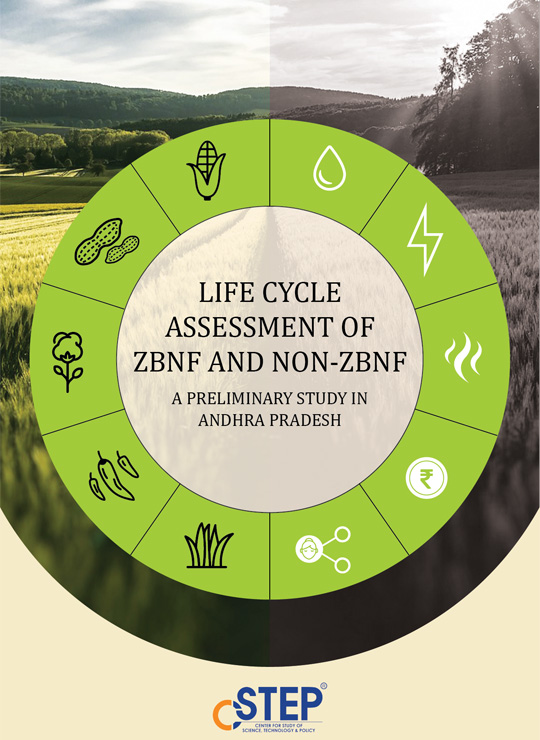
This report examines the nuances of Zero Budget Natural Farming (ZBNF) for select crops – paddy, groundnut, chilli, cotton and maize – in terms of water and energy consumption, emission, yield, and cost of cultivation.
Reduction potential: Water and electricity consumption (50%-60%), life cycle energy consumption (45%-70%), life cycle emissions (55-85%), cultivation cost (10%-40%) in select irrigated crops
Yield: The yield difference between ZBNF and non-ZBNF for chilli and paddy is negligible. For the remaining crops, non-ZBNF exhibits higher yields, with an increase in the range of 0.3–0.7 Mt/acre
Improved farmer income: Reduced dependency on inorganic chemical-based fertilisers shows higher revenue potential, even when yields from select crops are lesser.
Improved health: Reduced dependency on inorganic components promotes healthier farming lifestyle.
Road to sustainability: Promotion of mulching reduces environmentally-damaging practices like residue burning; similarly, multiple aeration method reduces methane emissions from paddy fields.
More about publication |
|
|---|---|
| Date | 29 January 2020 |
| Type | Reports |
| Publisher | CSTEP |
| Related areas | |
| Copyright | CSTEP |
Get in touch with us at
cpe@cstep.in