
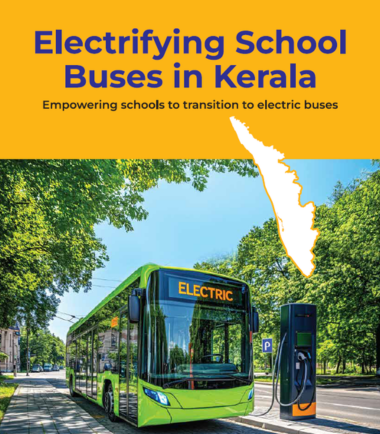
School buses offer a safe, timely, and cost-effective commute between residences and educational institutions. However, the majority of school buses in Kerala, India, are diesel-run and emit considerable PM2.5 and other pollutants that have negative externalities for children’s health, the environment, and the climate. Electric school buses with zero tailpipe emissions are a potential solution for these issues. As with any new technology diffusion, e-school buses require informed transition by stakeholders to accelerate adoption and scale-up. This demands stakeholder engagement and their capacity building.
The Energy Management Centre Kerala (EMC Kerala), with support from the Green Mobility team at CSTEP, engaged with more than 100 schools in Thiruvananthapuram and Kochi districts as well as original equipment manufacturers, charge point operators, electricity distribution companies, and education department officials to build awareness on the environmental and economic advantages of e-school buses. Comprehensive capacity-building programmes were undertaken to address gaps among school administrators in e-school bus procurement, financing, operations, and charging.
A handbook summarising the study findings and recommendations was released during the International Energy Festival of Kerala (IEFK’25), the annual flagship event of EMC Kerala. It serves as a guiding document for school administrators.
A related report, detailing the capacity-building exercises, total cost of ownership analysis for various e-school bus procurement pathways and financing, and vehicle-to-grid potential of e-school buses, was released on 11 June 2026.
More about publication |
|
|---|---|
| Date | 27 May 2026 |
| Type | Others |
| Contributors | |
| Publisher | CSTEP |
| Related areas | |
| Related project | |
Get in touch with us at
cpe@cstep.in