
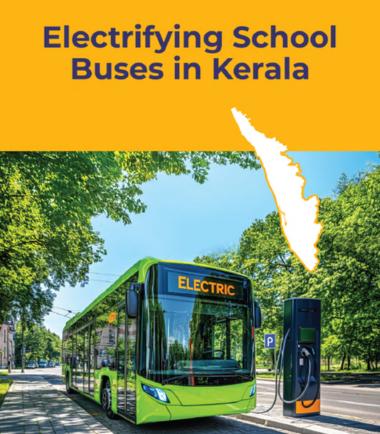
School buses are a vital part of Kerala’s education system, providing safe and reliable transportation for students and staff. However, nearly all school buses in the state currently operate on diesel, contributing to local air pollution and greenhouse gas emissions. Electric school buses (e-school buses) offer a cleaner and quieter alternative that can improve air quality, reduce emissions, and improve public health, including that of children. As Kerala advances its climate, energy security, and clean mobility ambitions, transitioning school transport fleets to electric vehicles presents an opportunity to achieve environmental, health, and energy benefits.
To support Kerala’s climate goals and strengthen preparedness for e-school bus adoption, CSTEP, with support from the Energy Management Centre (EMC) Kerala, undertook a capacity-building programme for schools and associated stakeholders. The study engaged with nearly 100 schools across Thiruvananthapuram and Kochi and consulted vehicle manufacturers, charge point operators, electricity distribution companies, and government officials. It aimed to build awareness about electric school buses, understand adoption barriers, evaluate implementation pathways, and identify measures required to facilitate a successful transition.
The study found that schools were generally receptive to adopting e-school buses, particularly because of the health and environmental benefits. However, high upfront costs and limited awareness of suitable procurement and financing mechanisms emerged as major barriers.
An assessment of procurement models, including outright purchase, battery leasing, dry leasing, gross cost contracts, and retrofitting, showed that leasing-based approaches and gross cost contracts can improve affordability for schools with limited capital, while retrofitting offers a viable pathway for ageing diesel fleets. The study also identified financing opportunities through green loans, concessional lending, corporate social responsibility funding, and public development funds.
In addition, the study found that e-school buses have the potential to support Kerala’s energy transition through vehicle-to-grid (V2G) applications. Their predictable operating schedules and long idle periods make them suitable for providing grid services such as frequency regulation and energy storage.
More about publication |
|
|---|---|
| Date | 11 June 2026 |
| Type | Reports |
| Contributors | |
| Publisher | CSTEP |
| Related areas | |
| Related project | |
| Pages | 64 |
| Copyright | CSTEP |
Get in touch with us at
cpe@cstep.in