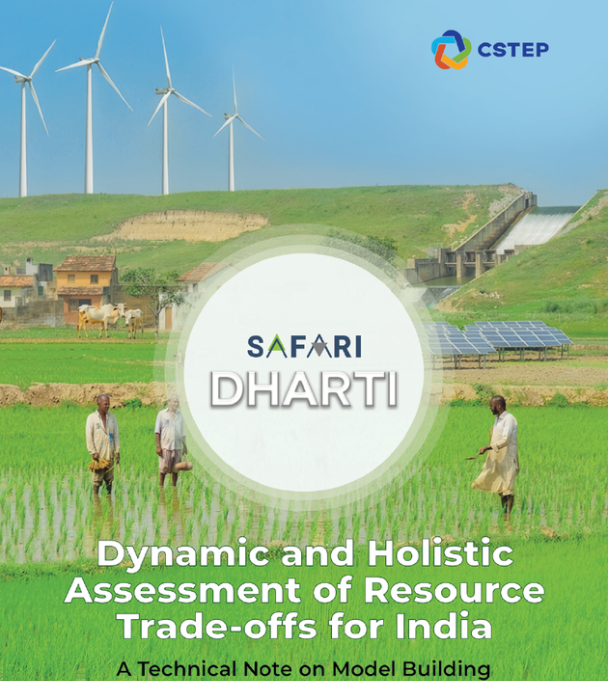
Land, a finite resource, is crucial for feeding a growing population, housing cities, storing carbon in forests, and hosting the renewable energy (RE) capacity needed to meet climate goals. In India, while targets are set nationally, states and regions make land decisions, and conditions differ widely.
This technical note documents DHARTI (Dynamic and Holistic Assessment of Resource Trade-offs for India), a system dynamics model that extends CSTEP’s SAFARI (Sustainable Alternative Futures for India) framework and its regional extension SAFARI-R by splitting land use across India’s five hydrometeorological zones: North, South, East, West, and Central.
The model was built on land-use and forest data from the National Remote Sensing Centre (NRSC), national land-use statistics, and the Forest Survey of India. It can be used to explore diverse questions related to land use and land-use change. For instance, is there enough land to meet India’s RE targets, and where will it come from? How do land-use changes differ between forest-rich and agriculture-dominant regions?
The model provides a decision-support framework for assessing how India’s land resources can be allocated under different low-carbon development pathways. It helps explore food-first, RE-first, and balanced development pathways, and shows where land constraints and trade-offs emerge.
SAFARI-DHARTI treats land as a core constraint rather than an afterthought, helping planners see how regional realities shape national climate and development goals. The note will be useful to researchers, modellers, and planners working on land use and low-carbon transitions.
More about publication |
|
|---|---|
| Date | 16 November 2026 |
| Type | Mini Reports |
| Contributors | |
| Publisher | CSTEP |
| Related areas | |
| Pages | 27 |
| Copyright | CSTEP |
Get in touch with us at
cpe@cstep.in