


Amid the global oil shocks caused by the West Asia conflict, there was a push from the Government of India to use public transport and adopt electric vehicles. A switch to electric school buses will align well with these priorities, as one in every seven buses in India is a school bus.
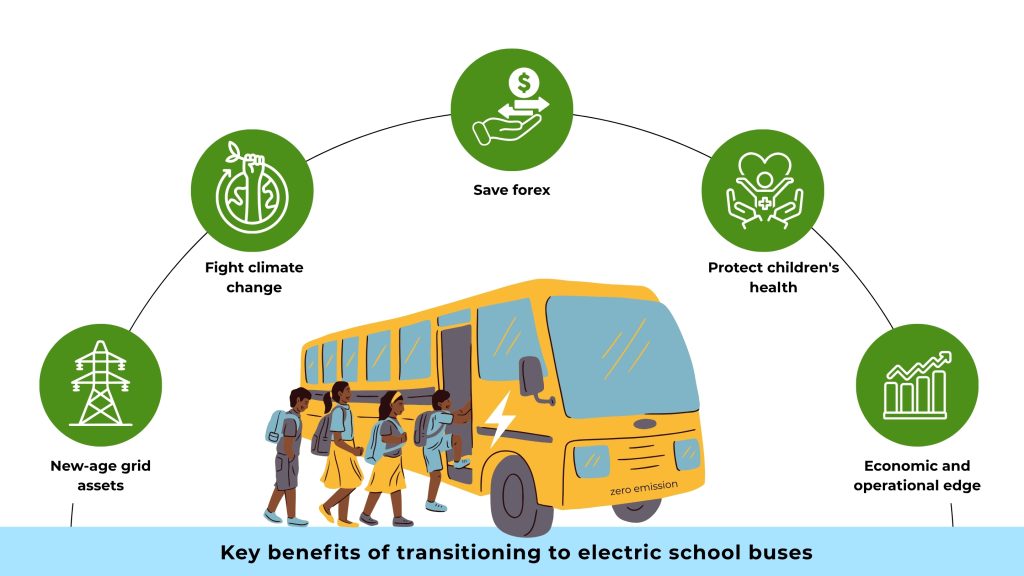
Electric school buses offer multiple benefits. Prime among them is reduced dependence on imported crude oil. In FY 2025–26, India’s crude oil import bill stood at INR 11 lakh crore (USD 122 billion). School buses consume approximately 15–30 million barrels of crude oil in a year, which is INR 13–27 thousand crore (USD 1.5–3 billion) in foreign exchange annually, almost 2% of India’s total imports. Transitioning school transport to electric mobility could help reduce oil import dependence while insulating operations from global oil supply disruptions and price hikes.
Transitioning school transport to electric mobility could help reduce oil import dependence while insulating operations from global oil supply disruptions and price hikes.
Electric school buses could also contribute to India’s climate commitments. India plans to cut its emissions intensity of GDP by 47% by 2035 from 2005 levels. This target strengthens the case for electric school buses, which could avoid up to 8 million tonnes of carbon dioxide emissions annually by eliminating tailpipe emissions compared with diesel buses. This is equivalent to about 2% of road transport sector emissions.
Alongside energy security and climate mitigation benefits, electric school buses could also be beneficial to students’ health. Students’ health is widely seen as an investment for future productivity, competitiveness, and economic growth. About 33% of India’s 200 million students travel by school bus. Most of these buses run on diesel and emit around 2 g of PM2.5 per kilometre (nearly100 times more than a motorcycle) and other harmful pollutants, affecting their health. Diesel exhaust is classified as carcinogenic by the International Agency for Research on Cancer. Since students (especially those aged 6 to 11 years) inhale twice the volume of air per kilogramme of body mass than adults and have developing organs and immune systems, they are disproportionately vulnerable. By eliminating tailpipe emissions, electric school buses emerge as a potential public health measure.
They also offer economic and operational advantages. Electric school buses have running costs of about INR 7/km, which is approximately 70% lower than the INR 25/km running costs of diesel buses. They also have lower lifetime maintenance costs because of simpler drivetrains and fewer wear-prone moving parts than conventional vehicles. Furthermore, long idle times and fixed routes and schedules eliminate range anxiety and facilitate charging without disrupting operational uptime.
Electric school buses have running costs of about INR 7/km, which is approximately 70% lower than the INR 25/km running costs of diesel buses.
In the era of demand flexibility measures, electric school buses can also be beneficial as potential grid assets. Kerala has implemented time-of-day tariffs, and Karnataka recently notified its framework for demand flexibility and demand-side management regulations. With other states likely to follow suit, electric school buses with their ability to provide vehicle-to-grid services, subject to fleet availability, could prove to be potential grid assets.
Together, these benefits make a strong case for electric school bus adoption. However, of the 5,300 electric buses registered across the country in FY 2025–26, only four were electric school buses. In contrast, more than 90,000 diesel buses were registered during the same period, including about 25,000 by schools and educational institutions, underscoring the untapped potential for electrifying India’s school bus fleet.
High upfront cost is a key barrier to adoption. A 7-meter electric school bus costs approximately 40 lakhs, twice as much as its diesel version with the same seating capacity. Most schools in India do not have the financial appetite for such outright capex. This diminishes the chances of electric bus purchase by schools. Thus, adoption can be enabled by asset-light pathways such as battery as a service (BaaS; battery leasing or subscription), gross cost contract (GCC), and other innovative business models.
The Center for Study of Science, Technology and Policy’s (CSTEP’s) analysis shows that a BaaS model could result in 8%–17% savings in the total cost of ownership of an electric school bus compared to diesel. GCC is suitable for school bus operators with higher daily runs (100 km or more). Operators can also benefit from lower lifetime opex costs of electric school buses compared to diesel.
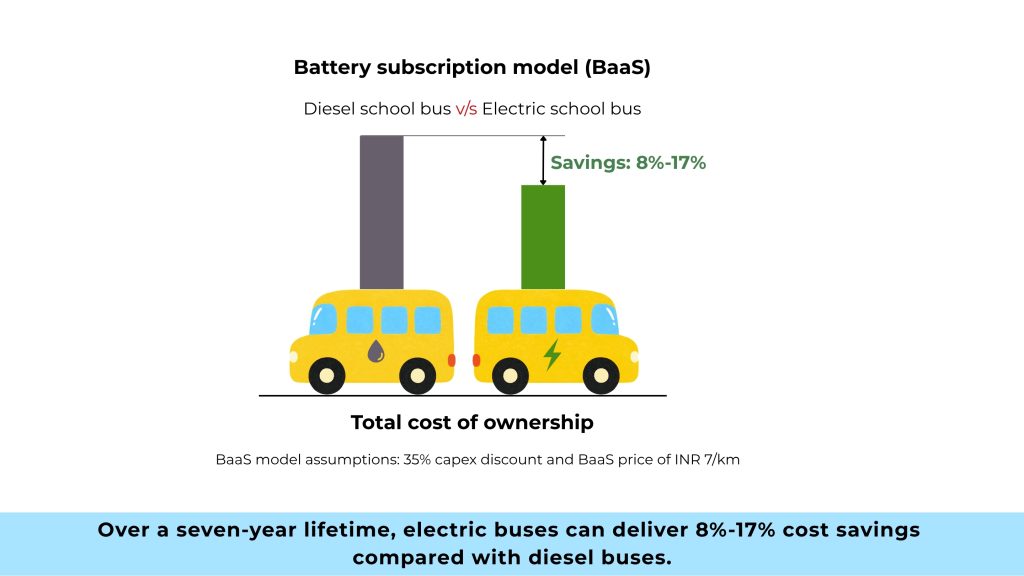
While BaaS is popular and has become mainstream in the Indian electric car market, it is mostly absent in the case of electric buses. Schools and bus operators can explore such a business model with electric school bus original equipment manufacturers. Further, they can explore demand aggregation in the current low-demand initial market phase to benefit from economies of scale and shared charging infrastructure.
Low asset utilisation limits the commercial viability of electric school buses. School buses, typically, do one trip in the morning to pick up students from residences and another in the evening to drop them back home. That is just two trips in a day, and in some cases, may be four trips a day, resulting in fewer daily km travelled (~50 km) and low utilisation.
Electric school buses are economically advantageous over diesel at higher utilisation levels (80–100 km or higher); therefore, schools and operators could explore asset-sharing models where the same electric school bus is utilised by more than one school and for other services such as an office shuttle. However, some state motor vehicle rules prohibit school bus usage for non-school commercial applications. Necessary amendments to these regulations are required to enable higher asset utilisation.
Except for a few schools adopting electric school buses mostly on a trial or pilot basis, the market in India remains nascent. Accelerating adoption will require collaboration across the school transport ecosystem. The government’s role will be critical in enabling this transition and raising awareness to overcome resistance stemming from unfamiliarity with new technology, high costs, and limited charging infrastructure.
The government’s role will be critical in enabling this transition and raising awareness to overcome resistance stemming from unfamiliarity with new technology, high costs, and limited charging infrastructure.
Policymakers could employ a combination of push and pull measures to accelerate adoption. Push measures include electrification mandates for school bus fleets, similar to the Delhi EV policy 2026, and establishment of low-emission zones or clean air zones around schools. Pull measures include making electric school buses eligible for purchase incentives under central (PM-EDRIVE) and state EV policies, tax exemptions, long-tenure low-interest loans, and payment security mechanisms (e.g., PM-e-Bus Sewa). Certification programmes can be introduced to recognise schools that adopt electric buses, providing them with a visible way to demonstrate their commitment to climate action and lower-emission transport.
The global oil shock is filtering into India’s school transport sector and has exposed its vulnerability. School bus operators in Maharashtra have reported financial stress due to rising fuel prices and asked schools for alternate day in-person classes. Similar demands are being raised in other states as well. To build a resilient school transport sector, meet its net-zero goals, and improve public health, India needs to transition its diesel school bus fleets on priority.
In our previous blog in the Measuring the Microns series, we briefly...

In this blog series titled Measuring the Microns, we examine why greater...
India’s transition to a cleaner power system has moved from a supply...
In the first blog in ‘The AI shift’ series, we examined what...
With growing electricity demand, renewable energy penetration, and storage requirements, Indian distribution...
In the first blog in ‘The AI shift’ series, we looked into...