
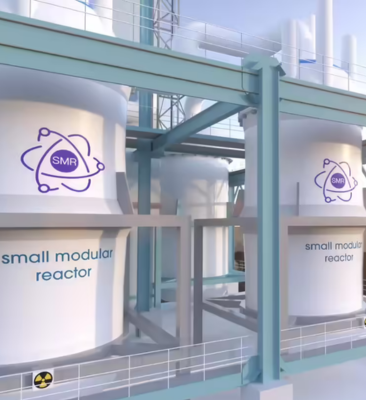
The government is investing in their development and deployment to meet thenation’s 2070 net-zero target. A strong focus on training and surveillance systems will ensure SMRs are deployed safely, building public trust and supporting India’s clean energy transition.The Union Budget 2026–27 extended the existing basic customs duty exemption on imports for nuclear power plants till 2035, irrespective of plant capacity.This continues the momentum from the 2025–26 Budget, which allocated ₹20,000 crore to develop and deploy small modular reactors (SMRs). SMRs are attracting attention due to their inherent advantages of advanced and passive safety featur,modularity, scalability, and suitability for remote locations. They also have shorter construction times and lower upfront costs than large nuclear plants.
As India scales up SMR deployment, public trust will be as crucial as technical capability. Clear communication highlighting the inherent safety of SMRs due to lower radioactive inventory (SMRs use smaller quantities of uranium than large nuclear plants) and advanced/passive safety systems (passive decay heat removal, natural circulation of emergency coolant, etc.) will be essential to improve public acceptance. Emphasising the immediate economic benefits and providing assurance of credible rehabilitation programmes will be add-ons. Ultimately, SMRs will succeed only if they are unquestionably safe. Thus, safety Thus, safety must lead SMR deployment in the SHANTI era through digital intelligence, layered surveillance, and an expansion of nuclear training.
Click here to read the full article
The article is co-authored by Dauji Saha (Former Consultant at CSTEP).
More About Publication |
|
|---|---|
| Date | 17 February 2026 |
| Type | Op-eds/Interviews/Press Releases |
| Contributors | |
| Publisher | ET Energyworld |
| Related Areas | |
Get in touch with us at
cpe@cstep.in