
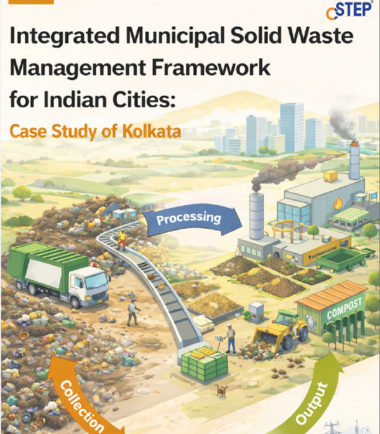
The city of Kolkata in West Bengal, India, has a population of around 15 million (resident and floating) and the amount of MSW collected is around 4000 tpd. Owing to the rapid saturation rate of the dump site at Dhapa and the financial difficulties faced by the compost plant, KMC are looking at ways to alleviate the problem. One of the options is to convert the MSW to electricity. Kolkata has a shortage of around 275 MW during peak hours and summer. IPP’s like Astonfield and monopolist CESC have tried in the past to explore this option but their feasibility reports to KMC have not convinced the latter to go ahead with such a project.
This study looks at the problem from a systems perspective and identifies the system to be a complex socio-technical one influenced by the role of institutions and environmental effects. It sets up a framework for carrying out a feasibility study for conversion of MSW to electricity in densely populated cities. It exemplifies the framework by taking Kolkata as a case study for this study.
The study research starts by asking for depth and insight into the actors involved in the MSWM scheme of Kolkata and what are their roles, interactions, power and attitude towards improving the scheme and how the scheme will impact them. A strategic stakeholder analysis based on the Institutional Analysis and Development (IAD) framework has been made to identify the stakeholder interactions and the space within which the stakeholders make their decisions in this socio-technical-ecological system. The problem owner is identified to be KMC and the other actors directly impacted by a change in the MSWM infrastructure are the ragpickers and scavengers at Dhapa and the opposition party. The containing system has the garbage farmers, waste collectors, population of Kolkata, industries and CESC. To improve the situation, all these stakeholders must collaborate with each other. CESC’s monopoly in the electricity market means that they need to participate in the project as well. The attitude of the population, ragpickers and scavengers, and the garbage farmers need to be transformed into a more positive one towards change. Interviews have been conducted to obtain information about the actors in this research.
An analysis of the existent MSWM scheme is then made to be able to understand the shortcomings and the possible scenarios for the future of MSWM in Kolkata. The KMC employs personnel to collect waste from households and markets and industries and transfers this MSW to the dumping site at Dhapa. Inefficient handling of intermediate storage in community bins leads to problems of overflowing bins and public nuisance.
The study then shifts focus into the technical aspects of the system. The characteristics of Kolkata’s MSW are analysed and the change in composition over time shows the increase in consumption of society and economic growth. The moisture content however is always on a higher side (50%) and this leads to the low calorific value of the MSW (1000-1100 kcal/kg). This shows the need for pre-treatment or drying of the MSW before conversion to electricity. From the technology superstructure, the relevant technologies of direct combustion, PYROPLEQ process (pyrolysis), WGT process and Kruppe-Uhde PreCon process (gasification) are analysed for electricity production using industry data and Cycle-Tempo simulations. The economics of each technology (including CDM aspects) are analysed in terms of NPV, IRR and payback period. Then the technologies are then compared in terms of energy efficiency and economic performance over their lifetimes.
The comparison shows that the most suitable technology in Kolkata’s context is the WGT process pilot plant since the PreCon process has not been proven on such a scale yet. This WGT technology is incorporated in the conceptual system design, which explains the change in the new feasible MSWM scheme and the roles that actors need to play in order to bring about this change. The social, institutional, technical, environmental and economic feasibility criteria are met by this system. This system design is derived from the generic framework that has evolved from this study research to carry out feasibility studies.
More About Publication |
|
|---|---|
| Date | 30 April 2021 |
| Type | Reports |
| Contributor | |
| Publisher | CSTEP |
| Related Areas | |
| Pages | 125 |
Get in touch with us at
cpe@cstep.in