
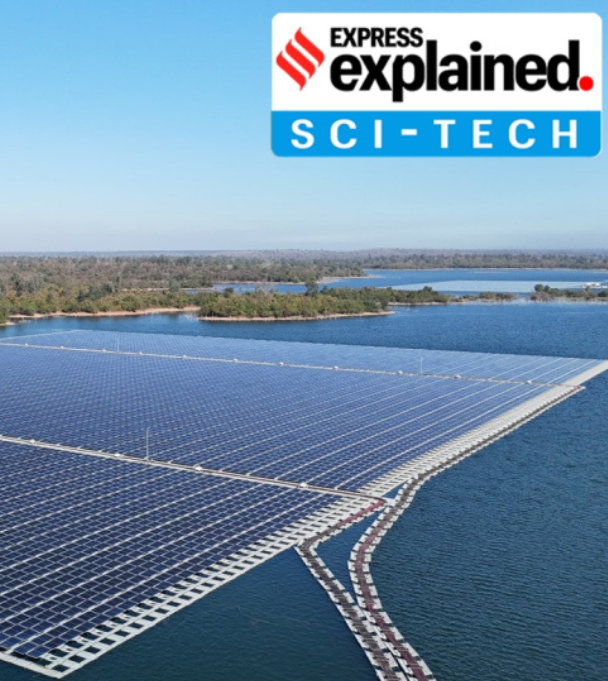
India’s installed solar capacity has grown rapidly, from 3 gigawatts (GW) in 2016 to over 160 GW in 2026, mainly through large-scale projects. But finding land for new projects is becoming harder as solar competes with urbanisation and agriculture, while the need for ecological conservation remains a priority. Policymakers, therefore, need to explore ways to expand solar capacity without requiring more land.
The recent approval of the Pradhan Mantri Surya Sarovar Yojana (PM-SSY) clearly signals the Indian government’s intent to promote land-neutral solar applications. The scheme aims to develop 5,000 megawatts (MW) of floating solar projects, with a total outlay of Rs 5,070 crore, making it the first dedicated national initiative to scale up floating solar adoption.
It also covers co-located energy storage systems with a minimum storage capacity of 2 hours, that is, 10,000 MWh (or megawatt-hour; 1 MWh equals 1 MW of power used or produced continuously for one hour) of cumulative storage capacity, to support grid stability. Although India has already made some strides in large floating solar plants, the scheme could provide the much-needed policy push to accelerate pan-India deployment.
Click here to read this Explainer
More about publication |
|
|---|---|
| Date | 23 August 2026 |
| Type | Op-eds/Interviews/Press Releases |
| Contributor | |
| Publisher | The Indian Express |
| Related areas | |
Get in touch with us at
cpe@cstep.in