
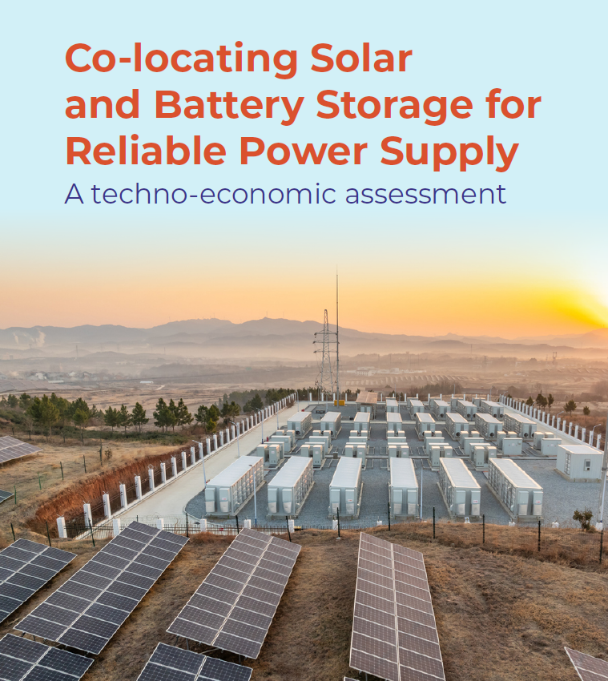
As India increases its use of renewable energy (RE), energy storage is becoming increasingly important. Storage allows renewable power to be supplied when it is needed, rather than only when it is generated. At the same time, RE procurement is moving towards more specific supply requirements, such as round-the-clock power, peak-power supply for set periods, and supply patterns that resemble conventional power generation.
As these requirements become more common, it is important to determine how solar power and battery energy storage systems (BESSs) can be combined effectively. Co-locating solar and BESS can make projects more efficient by allowing them to share land and grid infrastructure and use transmission capacity better.
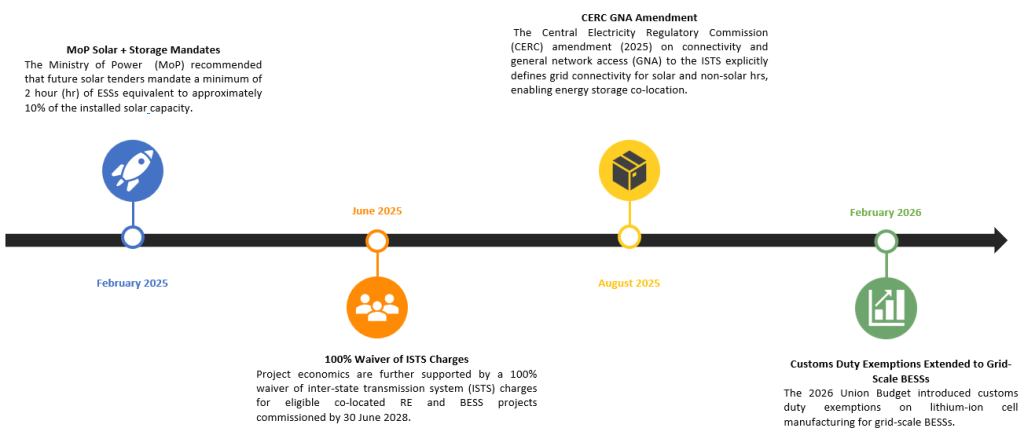
To address this, the Center for Study of Science, Technology and Policy (CSTEP) developed a framework to identify suitable locations and determine the appropriate size of solar and BESS projects. The framework was applied to a 100 MW continuous power supply requirement in Karnataka, considering delivery periods ranging from 2 to 24 hours and different delivery time windows. This helped identify how solar and BESS can be planned together to meet different power supply requirements while balancing three important factors: reliability, cost, and unused RE.
More about publication |
|
|---|---|
| Date | 6 October 2026 |
| Type | Briefs |
| Contributors | |
| Publisher | CSTEP |
| Related areas | |
| Pages | 16 |
Get in touch with us at
cpe@cstep.in