
India’s greenhouse gas emissions reached 4.2 gigatonne of carbon dioxide (CO2) equivalent (Gt CO₂e) in 2023, with the power and industrial sectors alone contributing nearly 60%. Projections suggest emissions could rise to 12–15 Gt CO₂e by 2070 if left unchecked. Major contributors include coal-based power generation and energy-intensive industries such as steel and cement.
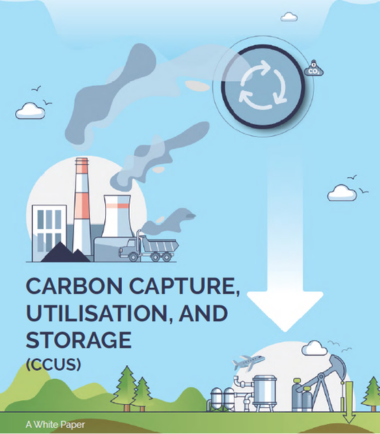
Achieving India’s net-zero target by 2070 requires a multi-pronged approach, combining renewable energy expansion, energy efficiency improvements, and advanced decarbonisation technologies. Integrating CCUS into an industry can theoretically abate 100% of its total emissions. CCUS works by capturing CO₂ from industrial and power plant emissions, utilising it in applications such as enhanced oil recovery or chemical production, and storing it in geological formations such as basalts and saline aquifers. India’s CO₂ storage potential is estimated at 395–614 Gt, indicating strong long-term feasibility.
The white paper provides a comprehensive assessment of CCUS in India, covering:
Sectoral emissions and CCUS potential
The study focuses on three high-emitting sectors: power, steel, and cement. These sectors are projected to emit a cumulative 50–70 Gt CO₂ by 2050, underscoring the urgent need for CCUS deployment to manage future emissions.
Technology readiness and innovation needs
The study reviewed the maturity of carbon capture technologies using the technology-readiness-level (TRL) framework, revealing that conventional capture methods, such as absorption and adsorption, are already at advanced stages of technology readiness (TRL 8–9). On the other hand, technologies such as microalgae-based, hydrate-based, and hybrid systems remain in early development stages (TRL 3–5). This highlights a dual need: the immediate deployment of mature solutions and continued investments in emerging technologies to ensure long-term scalability.
Choosing the right capture technology
Different industries require different CCUS approaches based on CO₂ concentration in emissions, the placement of the capture facility, economic feasibility, and required CO₂ purity. Key insights are:
More About Publication |
|
|---|---|
| Date | 24 March 2026 |
| Type | Mini Reports |
| Contributors | |
| Publisher | CSTEP |
| Related Areas | |
Get in touch with us at
cpe@cstep.in