
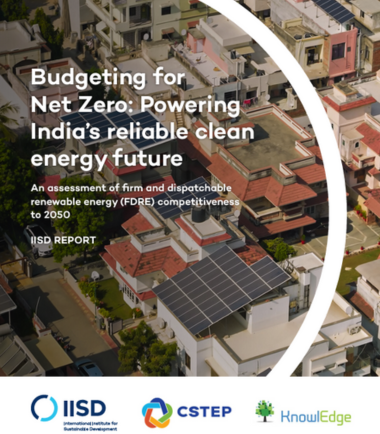
India’s electricity system is evolving rapidly in response to rising demand, a changing resource mix, and the need for round-the-clock clean power. While coal remains the dominant source of reliable electricity, the declining costs of solar, wind, and battery storage are opening realistic alternatives. FDRE projects deliver clean power in line with specific demand profiles, shifting India from generation-based procurement to demand-based renewable solutions. However, uptake has been slow and questions remain around cost competitiveness, revenue certainty, and investment risk for developers and distribution companies.
This study evaluates three core questions: whether FDRE can match or undercut new thermal power on cost; what kind of government support (if any) would be required to close any cost gap; and how FDRE deployment affects economic growth, employment, air pollution, and climate outcomes. Using scenario modelling, externality assessments, and stakeholder consultations, we compare FDRE cost trajectories with new pithead coal plants, estimate cost gaps to 2050, and explore the broader economic benefits of scaling FDRE.
Our findings suggest that FDRE can provide reliable clean power at competitive prices, but that market design and tender structure will determine the pace and scale of deployment. The recommendations focus on practical changes that improve developer certainty, reveal true resource costs, and align energy procurement with long-term national priorities.
The report was co-authored by By Sunil Mani, Andrea Bassi, Tara Laan, Swasti Raizada, and Godwin Paul Chandra Sekar from IISD and Upasna Ranjan (Former Senior Analyst at CSTEP).
More About Publication |
|
|---|---|
| Date | 9 December 2025 |
| Type | Reports |
| Contributor | |
| Publisher | IISD |
| Related Areas | |
Get in touch with us at
cpe@cstep.in