
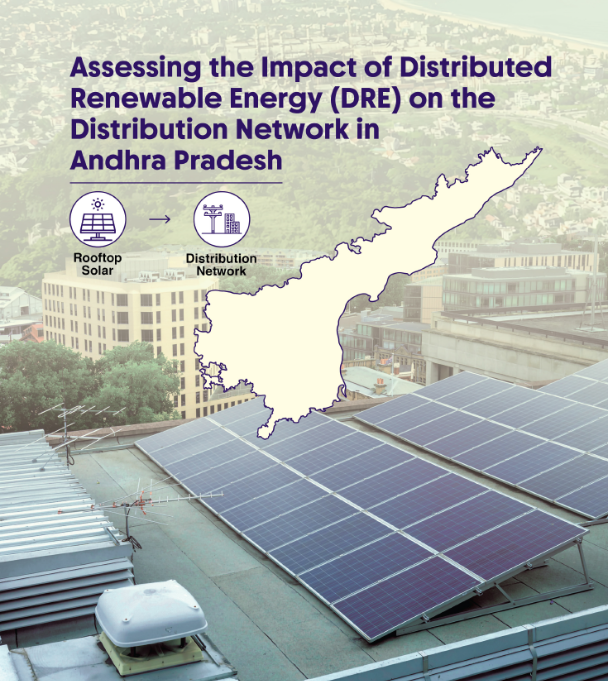
Assessing the impact of distributed renewable energy (DRE) on the distribution network in Andhra Pradesh

Published 5 October 2026

Setting the context

Andhra Pradesh’s power demand is rising with industrial growth, urbanisation, data centres, and green hydrogen plants. As rooftop solar (RTPV) and other forms of distributed renewable energy (DRE) expand, distribution networks could face overloaded transformers, voltage fluctuations, reverse power flow, and higher stress during evening peaks. 


Why was the study done?

RTPV and DRE are expanding rapidly in the state, but their impact on local distribution networks is not well understood. The study assessed how RTPV and battery energy storage systems (BESS) affect 11 kV feeders, looking at transformer loading, voltage, technical losses, DISCOM revenues, and consumer bills. It also examined possible BESS business models to inform future network planning and investment.


How was the study done?

CSTEP and APEPDCL studied an industrial feeder (HBL) and a residential feeder (KRPM) in Visakhapatnam. Field surveys were used to map the networks and collect data. Hourly time-series load-flow simulations were carried out for four scenarios: business as usual (BAU) 2025, BAU 2030, BAU 2030 with RTPV, and BAU 2030 with RTPV and BESS. The study also assessed the financial implications for DISCOMs and consumers. 


What did the study find?

  • By 2030, demand growth could lead to more overloaded distribution transformers (DTs) and greater voltage deviations. 
  • On the industrial feeder, daytime demand matched solar generation. RTPV reduced transformer loading from 104% to 78%, improved voltage, reduced losses, and eliminated DT overloading. 
  • On the residential feeder, evening demand remained a challenge. Adding BESS reduced peak DT loading from 160% to 131%, improved voltage, reduced losses, and eliminated reverse power flow. All overloaded DTs were brought within safe limits. 
  • RTPV reduced consumer bills by lowering energy charges. The resulting reduction in DISCOM revenue was offset by avoided power purchase costs. Of the BESS business models assessed, Build–Own–Operate (BOO) was the most viable under the study assumptions. 


Key recommendations

  • DISCOMs should consider transformer capacity, voltage levels, demand patterns, and reverse power flow when planning network upgrades. 
  • Develop rooftop solar-ready distribution corridors in urban, industrial, and commercial areas with high daytime electricity demand. 
  • Monitor feeders and DTs using smart monitoring systems and digital planning tools to identify stress points early, plan battery storage, and guide grid upgrades. 
More about publication
Date 5 October 2026
Type Reports
Contributors
Publisher CSTEP
Related areas
Pages 48

Have a query?

Get in touch with us at

cpe@cstep.in