


The link between rising levels of greenhouse gases (GHGs) and changing climatic patterns was first definitively put forth in 1898 by Svante Arrhenius, a Swedish scientist. In the decades since Arrhenius, climate science has developed considerably, establishing with even greater conviction that climate change is closely connected to anthropogenic GHG emissions. As a result, there is a growing global awareness of the importance of reducing emissions in an effort to mitigate climate change.
However, reducing emissions necessitates a precise understanding of their sources. This is where greenhouse gas accounting comes into the picture. GHG inventories are essentially documentations of the emissions of countries over periods of time. They provide disaggregated data on levels and sources of emissions, often capturing in great detail activities under different sectors and the different greenhouse gases that result from them.
The most commonly used format by countries is one prescribed by the United Nations Framework Convention for Climate Change (UNFCCC). The UNFCCC is a global treaty adopted in 1992 to ensure uniformity in GHG accounting and regulate the process. It sets out reporting requirements for member countries (known as Parties to the UNFCCC), categorising them as Annex I (developed and transitional) and non-Annex I (developing) countries.
To ensure uniformity and comparability in reporting, the UNFCCC prescribes a list of gases to account for, and key sectors and subsectors to provide data for. It also provides detailed information on estimation methods, types of activity data to collect under each sector, and default emission factors for these activities.
Why is sectoral accounting important? Sectoral accounting makes it possible to understand precisely which activities contribute most to emissions and why. Understanding this can help policymakers devise strategies to modify the way in which these activities are carried out (in terms of technology, fuel type, etc.). This can go a long way in generating mitigation strategies to meet emissions reduction targets. Inventories are also useful inputs while projecting long-term emission scenarios.
In 2015, stressing on the concept of Common but Differentiated Responsibilities (CBDR) in climate action, the Paris Agreement was created. It urges Parties to the UNFCCC to reduce their GHG emissions in order to limit global temperature rise to less than 2-degree C. The agreement, however, recognised that climate action cannot happen overnight, and needs to be periodically strengthened. Therefore, it made provisions for a mechanism informally known as the ratchet mechanism. As per this, countries are required to monitor and periodically update their emissions reduction targets through voluntary commitments known as Nationally Determined Contributions (NDCs). NDCs are set to be updated every five years, with interim review processes.
As a non-Annex I country, India is required to submit periodic reports of its GHG emissions to the UNFCCC in the form of Biennial Update Reports (BURs) and National Communications. Its most recent submission, First Biennial Update Report, records India’s sectoral emissions for the year 2010.
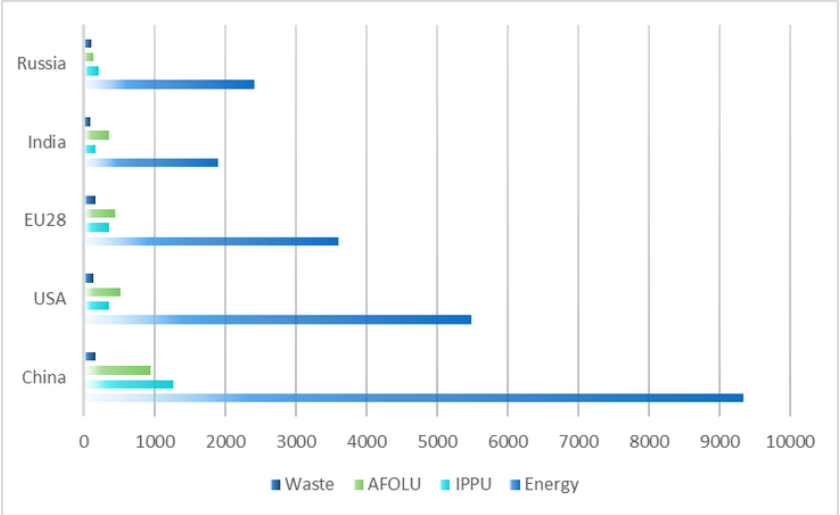
India is currently the fourth largest emitter of GHGs but has among the lowest emissions per capita in the world. Similar to other major emitters (China, USA, EU28 and Russia), 70% of its emissions are from the energy sector (Figure 1). India’s current NDC aims for a 33–35% reduction in emissions intensity of GDP by 2030, from 2005 levels. Regular GHG inventories are therefore going to play an even greater role in the future in assessing whether countries like India are on track to meeting their emissions reduction targets. Regular inventories are particularly useful in helping keep emissions and sources in check and assisting policymakers in developing sectoral strategies for
emissions reduction.
The GHG Platform India reports that some of the biggest challenges with creating a GHG inventory are associated with data collection. Data is often not available in an easily collectable manner. As a first step, sub-sectoral data needs to be recorded at regular time intervals and made publicly accessible in order to facilitate creating a robust database. Data collection and verification is a challenge particularly in those sectors where activities are not regularly monitored or recorded. Moreover, accuracy can prove difficult to ensure, particularly at sub-national levels.
Also, addressing issues related to informal sector accounting through more coordinated efforts between different governmental and private agencies is imperative to ensure that the inventory process is as rigorous as possible. This is a vital step in supporting future mitigation efforts. Overall, India urgently needs to develop a more transparent and robust sub-sectoral database to facilitate better mitigation analysis and planning.
Center for Study of Science, Technology and Policy (CSTEP) is a multidisciplinary policy research organisation which enriches policymaking with innovative approaches using science and technology. CSTEP incorporates social and economic perspectives to a scientific solution to ensure that the research has a long-term impact and meaningful outcomes. CSTEP constantly aims at science and technology-enabled policy options for an inclusive and equitable economic growth.
Further reading
http://www.wri.org/blog/2012/11/making-progress-measurement-reporting-andverification-mrv-cop-18
https://www.ipccnggip.iges.or.jp/public/2006gl/pdf/1_Volume1/V1_1_Ch1_Introduction.pdf

In our previous blog in the Measuring the Microns series, we briefly...

In this blog series titled Measuring the Microns, we examine why greater...

India’s transition to a cleaner power system has moved from a supply...

In the first blog in ‘The AI shift’ series, we examined what...
With growing electricity demand, renewable energy penetration, and storage requirements, Indian distribution...

In the first blog in ‘The AI shift’ series, we looked into...