
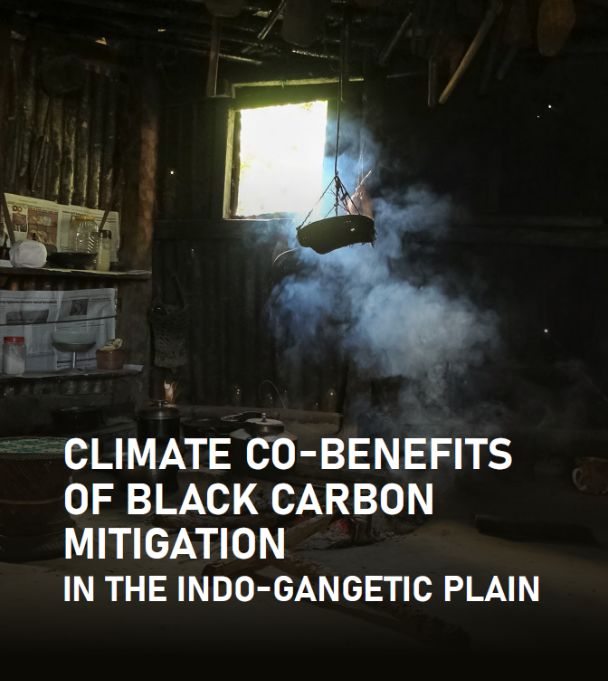
Climate change and poor air quality are among the most pressing environmental challenges today. In addition to long-lived greenhouse gases, certain short-lived climate pollutants can accelerate global warming while also degrading air quality. Black carbon is one such pollutant. It contributes to atmospheric heating by absorbing visible light and is also a major component of PM2.5, which is associated with severe health risks and life-threatening diseases.
This study evaluates black carbon emission-reduction scenarios to identify interventions that deliver substantial improvements in air quality and public health along with climate co-benefits across the Indo-Gangetic Plain (IGP).
Air quality benefits and corresponding health benefits were estimated using a reduced complexity air quality model called REACH (Rapid Estimation of Air Concentrations for Health). The health benefits were estimated based on reductions in total PM2.5 concentrations under the defined emission scenarios. Climate co-benefits were assessed using CO2-equivalent metrics and changes in radiative forcing across different emission-reduction scenarios.
An airshed-based, multisectoral approach with coordinated action across multiple states can deliver considerable regional climate and health benefits by enabling substantial reductions in black carbon concentrations.
More about publication |
|
|---|---|
| Date | 20 August 2026 |
| Type | Reports |
| Contributors | |
| Publisher | CSTEP |
| Related areas | |
Get in touch with us at
cpe@cstep.in