
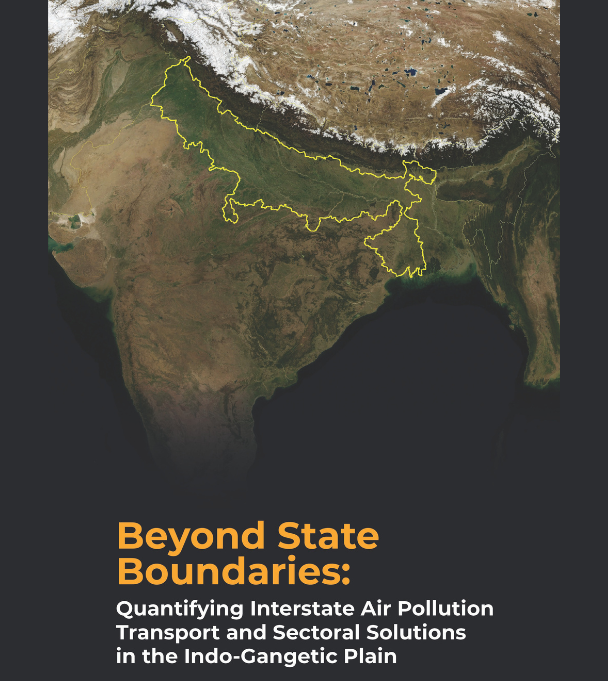
The Indo-Gangetic Plain (IGP) faces fine particulate matter (PM2.5) levels that far exceed national air quality standards. Emission-intensive activity combined with unfavourable meteorological conditions during the post-monsoon and winter seasons drives severe pollution episodes—most visibly in the National Capital Region (NCR)—but these episodes cross administrative boundaries.
City-centric efforts under the National Clean Air Programme focusing only on local emissions mitigation are not sufficient to improve air quality beyond a limit. Tackling local air quality requires an additional airshed-based framework that enables coordinated action across multiple jurisdictions, as envisaged through institutions such as the Commission for Air Quality Management in the NCR and Adjoining Areas. This study identifies the major pollution sources across the IGP and feasible mitigation measures at a regional scale.
The study used the Weather Research and Forecasting model coupled with the Comprehensive Air Quality Model with Extensions (WRF–CAMx), driven by global emissions inventories, to apportion PM2.5 sources across IGP states and validated against monitoring data.
NCR’s annual PM2.5 averages 67.9 µg m⁻³, with local sources (mainly residential) contributing 28% and about 39% from other regions of India. Similar sources also affect air quality in Punjab, with PM2.5 concentrations spiking to 98.6 µg m⁻³ during the post-monsoon months (October–November) due to episodic emissions from agricultural waste burning. High PM2.5 levels continue to persist during winter (December–February), with residential sources driving more than half of local PM2.5 pollution. Pollution sources are dispersed, seasonal, and multi-sectoral, meaning interventions at the state or sectoral level will yield limited gains.
The WRF–CAMx setup was also used to test multiple emission reduction scenarios. A combined 50% reduction across residential, energy, industrial, transport, and agricultural waste-burning sources, along with a 90% reduction in emissions from waste incineration, reduced annual average PM2.5 by 23% in NCR and 20% in Punjab.
More about publication |
|
|---|---|
| Date | 19 August 2026 |
| Type | Reports |
| Contributors | |
| Publisher | CSTEP |
| Related areas | |
Get in touch with us at
cpe@cstep.in