
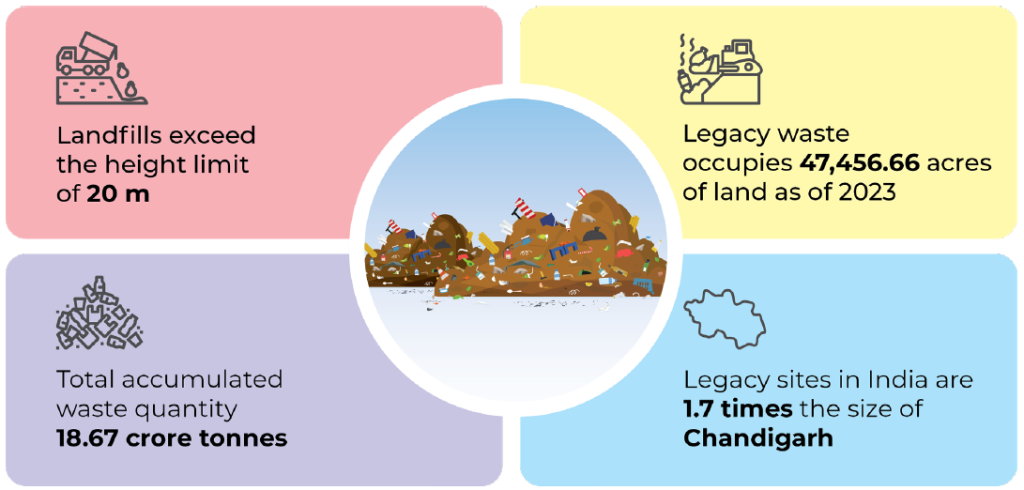
India’s legacy waste crisis is one of the most pressing environmental, health, and urban issues the country is facing today. Legacy waste refers to the millions of tonnes of solid waste accumulated over decades in landfill sites across India. Across the country, approximately 47,456 acres of land lie buried under nearly 18.67 crore tonnes of waste. These dumpsites result from years of unsegregated disposal, plastic-wrapped dumping practices, and population growth. Many of these dumpsites now lie within cities and have exceeded their designed capacity and height limits. Legacy waste is no longer a silent by-product but a volatile national challenge.
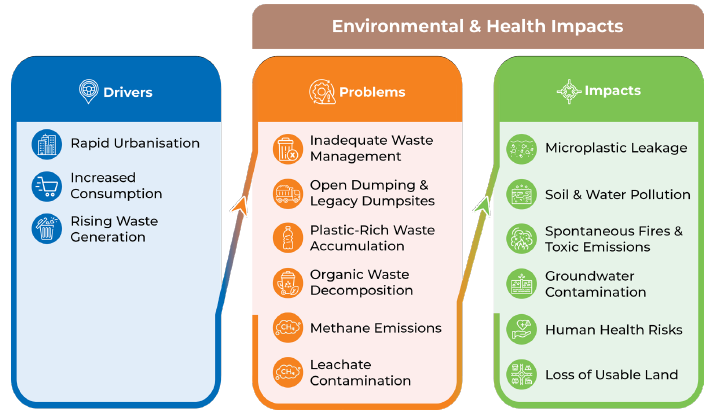
Unlike fresh waste, legacy waste is aged and chemically transformed over the years. It is a persistent source of pollution. Anaerobic decomposition within these dumpsites generates methane, which has a significantly higher global warming potential than carbon dioxide. Frequent landfill fires, especially in the summer, continue to burn for days, releasing toxic fumes and particulate matter that disproportionately harm surrounding communities. Beneath the surface, toxic leachate seeps into the soil and contaminates groundwater and aquifers, threatening long-term water supply. In addition, the large amount of valuable land locked up—especially in countries like India, with its large population and growing land demands—underscores the seriousness of the issue.
The country’s policy architecture mandates and guides various management techniques for these landfill dumpsites, such as biomining, remediation, scientific capping, and monitoring, especially under the new Solid Waste Management Rules (2026). However, the implementation gap remains a constant challenge, reflecting the disconnect between policy intent and on-ground application. Weak characterisation of waste data remains a major bottleneck, hindering efficient processing and the development of value chains for these waste streams. Opportunities such as recovering refuse-derived fuel (RDF), recyclable metals, and construction-grade materials, along with landfill gas collection, can help reduce pollution while also generating revenue. However, waste heterogeneity, high operational costs, and technical limitations hinder the implementation of such solutions.
To address the legacy waste crisis effectively, it is crucial to adopt a site-specific, data-driven remediation strategy. Key recommendations are as follows:
• Comprehensive baseline characterisation of dumpsites
• Integration of informal workers into formal waste value chains
• Strict adherence to biomining and pre-processing guidelines
• Improved monitoring and accountability mechanisms
• Structured public–private partnerships supported by predictable revenue models
• Strengthened institutional capacity and technical training at the municipal level
Legacy waste is not merely a historic burden but a missed economic opportunity. With coordinated efforts in policy enforcement, technical rigour, and financial investment, this crisis can be transformed into a pathway for climate mitigation, resource recovery, and sustainable development.
More about publication |
|
|---|---|
| Date | 30 April 2026 |
| Type | Briefs |
| Contributors | |
| Publisher | CSTEP |
| Related areas | |
Get in touch with us at
cpe@cstep.in