
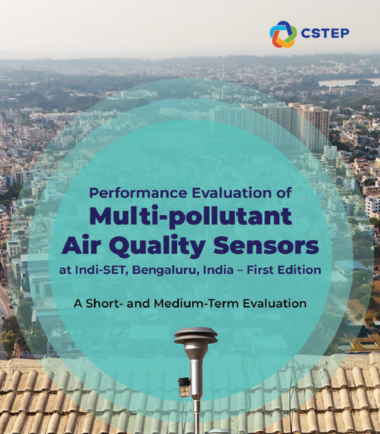
While low-cost air quality sensors offer an affordable and promising way to expand pollution monitoring in developing countries such as India, their readings vary widely unless properly calibrated for local conditions. Bengaluru-based think tank the Center for Study of Science, Technology and Policy’s (CSTEP’s) latest report, Performance Evaluation of Multi-pollutant Air Quality Sensors at Indi-SET, Bengaluru, India – First Edition; A Short- and Medium-Term Evaluation, brings this to the fore.
The report discusses how to improve the testing, calibration, and maintenance of air quality sensors before deploying them. The findings come from an extensive evaluation of 48 multi-pollutant sensor devices from different manufacturers at the India Air Quality Sensor Evaluation (Indi-SET) Facility at CSTEP’s Air Quality Lab. The sensors were placed next to a reference monitor and observed for up to 8 months to check their durability and reliability. As part of the study, readings were taken for particulate matter (PM2.5 and PM10), nitrogen dioxide, ozone, and carbon monoxide.
Click here to read the full report
More about publication |
|
|---|---|
| Date | 23 April 2026 |
| Type | Op-eds/Interviews/Press Releases |
| Contributor | |
| Publisher | CSTEP |
| Related areas | |
Get in touch with us at
cpe@cstep.in