


Approximately one-third of the global population (2.5–3 billion), including up to 90% of rural households, depend on solid fuels (SFs) for cooking, heating, and lighting. Developing countries — driven by their socioeconomic status — burn around 2.2 million tonnes of SFs per day, with biomass and coal being the primary fuels. This results in the release of various pollutants, such as polycyclic aromatic hydrocarbons, heavy metals, volatile organic carbons, black carbon, particulate matter (PM), sulphur dioxide, carbon monoxide, and nitrogen oxides, thereby contributing to indoor or household air pollution (HAP). According to a study by the International Institute for Applied Systems Analysis, around 2.4 lakh premature deaths per year in India are associated with HAP.
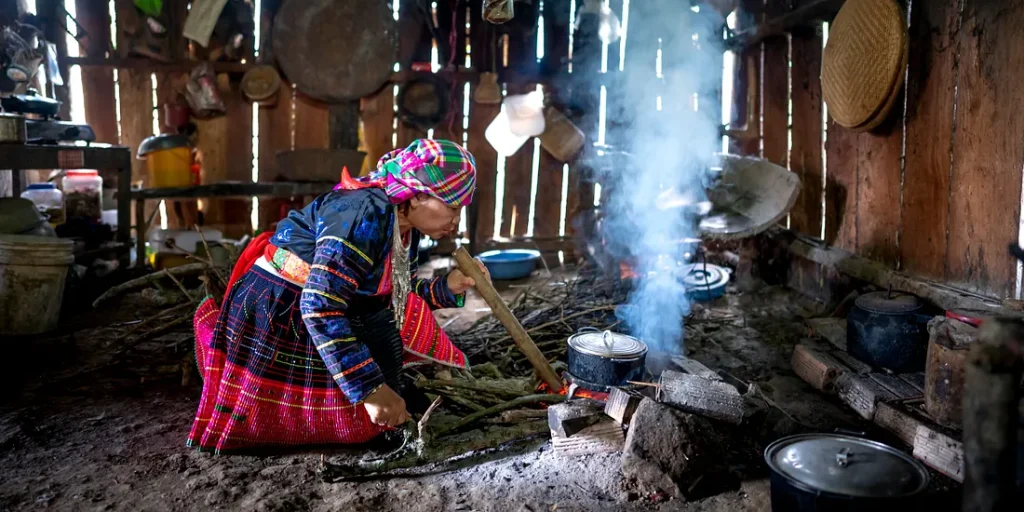
According to another study in The Lancet, 1.67 million deaths in India in 2019 were attributable to HAP, with women accounting for 60% of these deaths. This may be because women are more involved in household work, with girls often missing out on school to do so. Inadequate ventilation and unvented cooking stoves also increase women’s vulnerability to HAP.
Further, a 2018 report by the Global Alliance for Clean Cookstoves found that SFs increase the risk of chronic obstructive pulmonary disease by 50% in women. Despite these impacts, mitigation efforts have largely ignored gender inequalities in clean energy access and HAP in India.
The United Nations has acknowledged the importance of addressing air quality by incorporating air quality and pollution targets into three sustainable development goals (SDGs) — SDG 3 (Good Health and Well-being), SDG 5 (Gender Equality), and SDG 7 (Affordable and Clean Energy). However, the increasing levels of HAP can hinder the achievement of SDG targets by 2030.
Achieving SDGs and addressing HAP go hand in hand due to their interconnectedness. Alleviating HAP, which affects health and creates additional cost burdens, contributes to achieving good health and well-being. As marginalised communities are at greater risk from HAP, the socio-economic empowerment of such communities through non-farm-based jobs and self-help groups can reduce both poverty and HAP.
Further, measures to transition away from SFs, such as empowering women and low-income groups with equal education opportunities and increasing the affordability of clean energy sources, will not only improve air quality but will also lead to gender equality. Reducing HAP can also help in limiting climate change impacts, which marginalised communities are more vulnerable to.
The National Clean Air Programme (NCAP) in India targets a 20%–30% reduction in PM levels in 131 non-attainment cities by 2024. It also directs the cities to prioritise their city-specific polluting sectors, identified through emission inventory (EI) studies. However, efforts are lacking at the local level.
Another plan — Pradhan Mantri Ujjwala Yojana (PMUY) — is providing free LPG connections to low-income households to reduce air pollution and promote clean cooking fuel. However, because of their refilling cost and free availability of SFs, unclean fuels are still widely used in India.
Interventions that positively impact HAP, such as distributing clean cookstoves, promoting behavioural change through education, improving housing conditions by providing better ventilation and temperature control, and promoting biogas production at household and community levels, can prevent HAP in India. Addressing gender inequality by empowering women and girls and educating them on the harmful impacts of indoor biomass burning can also help.
In an EI study, the Centre for Study of Science, Technology and Policy (CSTEP) identified probable measures to mitigate HAP in Ramgarh, Jharkhand. The study advocates using cleaner fuels for cooking, establishing more LPG distribution centres, and facilitating door-to-door delivery of LPG cylinders. Incentivising advanced chulhas and restricting coal supply should also be promoted.
To further provide comprehensive solutions for air pollution control, we present the India Clean Air Summit (ICAS) — our flagship event addressing air pollution in all areas, including the household sector.
The author works in the area of air pollution at the Centre for Air Pollution Studies (CAPS) at CSTEP, a research-based think tank.
India’s transition to a cleaner power system has moved from a supply...

In the first blog in ‘The AI shift’ series, we examined what...
With growing electricity demand, renewable energy penetration, and storage requirements, Indian distribution...

In the first blog in ‘The AI shift’ series, we looked into...
Following our photo essay from the field, this blog looks at the...

In this three-part blog series titled ‘The AI shift’, I examine how...