

Can frontline agriculture officials turn daily climate disruptions into regional insights — and help shift the narrative from vulnerability to resilience?
In Odisha, where climate variability has become an everyday reality for farmers and government functionaries alike, this question feels urgent. This first blog in the ‘Voices From Climate Frontline’ series focuses on two activities undertaken during a climate training workshop to explore how regional distinctions shape government officers’ perception and understanding of climate risks.
As part of a larger initiative to build climate resilience in the state’s agriculture and allied sectors, the Department of Agriculture and Farmers’ Empowerment (DA&FE), Government of Odisha, and the Center for Study of Science, Technology and Policy (CSTEP), in collaboration with the Climate Resilience Cell (CRC), organised a 2-day capacity-building training workshop titled ‘Climate Change: Science, Impacts, and Solutions’ across three batches between 7 and 12 April 2025.
The goal? To strengthen climate literacy among state- and district-level officials who are not only responsible for implementing schemes but are also primary responders to local vulnerabilities. Despite their crucial role, they often have limited exposure to climate science or tools for adaptation planning. Strengthening their understanding of climate change means better decisions, more locally aligned interventions, and a stronger foundation for long-term resilience.
The training workshop brought together officers from all the 30 districts of Odisha, with representation from each of the three major directorates in DA&FE — Agriculture and Food Production, Horticulture, and Soil Conservation and Watershed Development. The district representatives were grouped into three regional clusters, with each reflecting distinct climatic and geographic characteristics, shaping how risks such as drought, cyclones, floods, and heatwaves are experienced and managed.
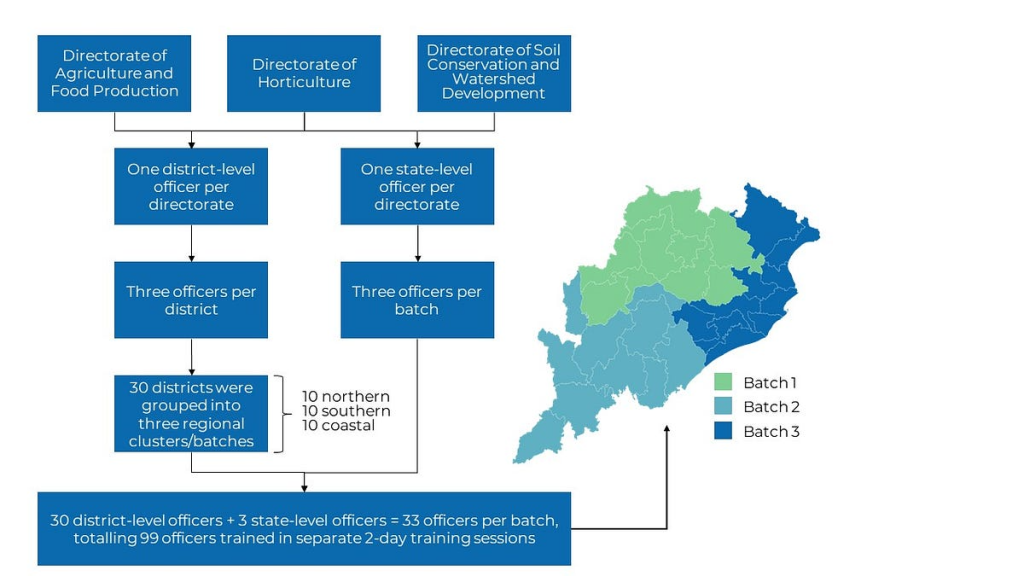
Regional cluster grouping for training
As a first step, a pre-training survey helped identify existing knowledge gaps and tailor the sessions accordingly. Over two days, participants engaged in several hands-on activities designed to contextualise climate risk to their field realities. Finally, a post-training feedback form was used to evaluate the relevance and usefulness of the sessions and to gauge improvement in clarity regarding climate concepts.
The first group exercise involved unpacking how a single climate hazard can cause both direct and indirect impacts. Drawing from the training session ‘Sectoral Impacts of Climate Change’, participants were encouraged to think beyond immediate damages and trace the ripple effects of a single climate trigger across sectors and timeframes.
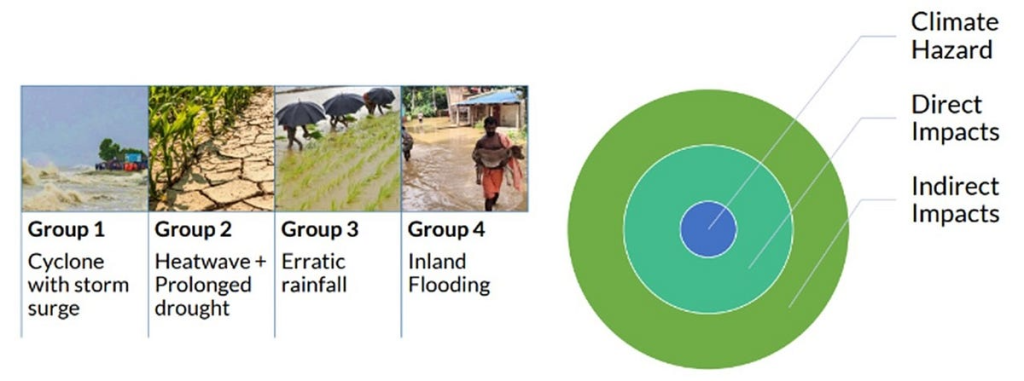
Climate impact web — a circular diagram with the assigned hazard placed at the centre, followed by direct and indirect impacts of the hazard
Each batch was divided into four groups, and each group was assigned one climate hazard: cyclone with storm surge, heatwave and prolonged drought, erratic rainfall, or inland flooding. Participants of each group mapped out the direct impacts (those experienced immediately after the hazard, such as crop loss or infrastructure damage) in the inner ring and indirect impacts (long-term or cascading effects such as food insecurity or labour migration) in the outer concentric ring, simulating the ripple effect of a single climate trigger
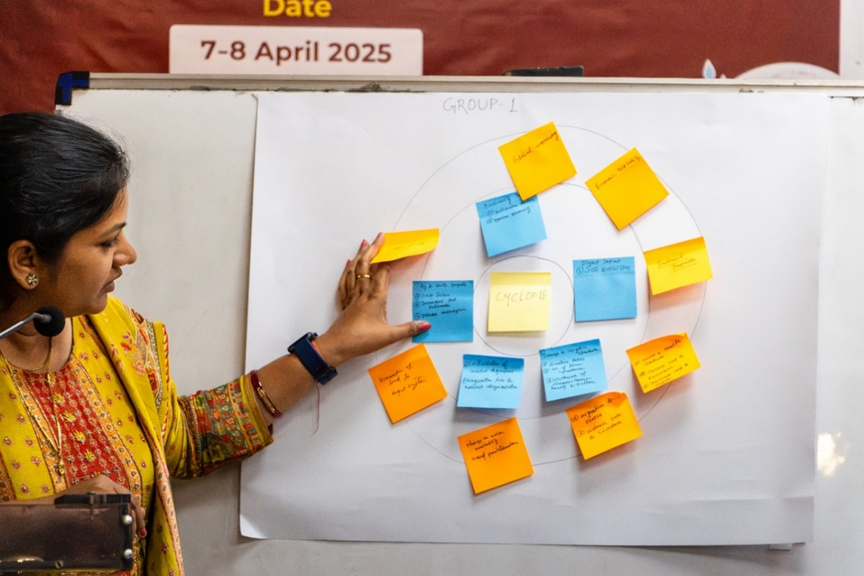
A participant from Group 1, Batch 1, presenting the final output from the ‘One Land, Many Links’ activity
Nine groups participated in this exercise — three from each training batch, representing the three directorates.
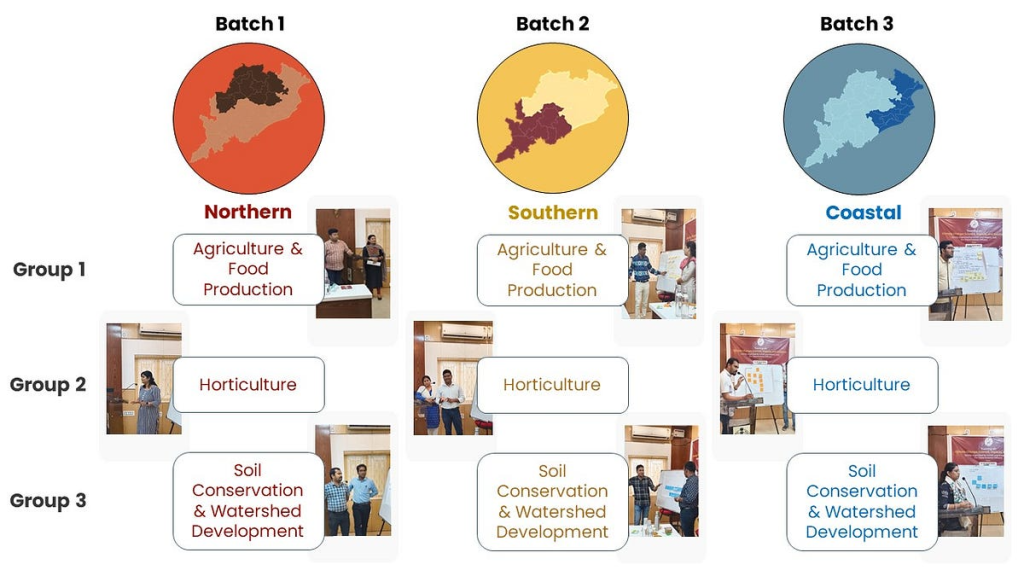
Groups that participated in the activity
Each group was guided through a structured approach to assess climate risks, aligning with the first five steps of a standardised risk assessment methodology. Participants were directed to contextualise these steps by drawing on their regional experiences and sectoral priorities. They identified relevant climate hazards, selected appropriate spatial and temporal scales, and proposed indicators for hazard, exposure, and vulnerability assessments.
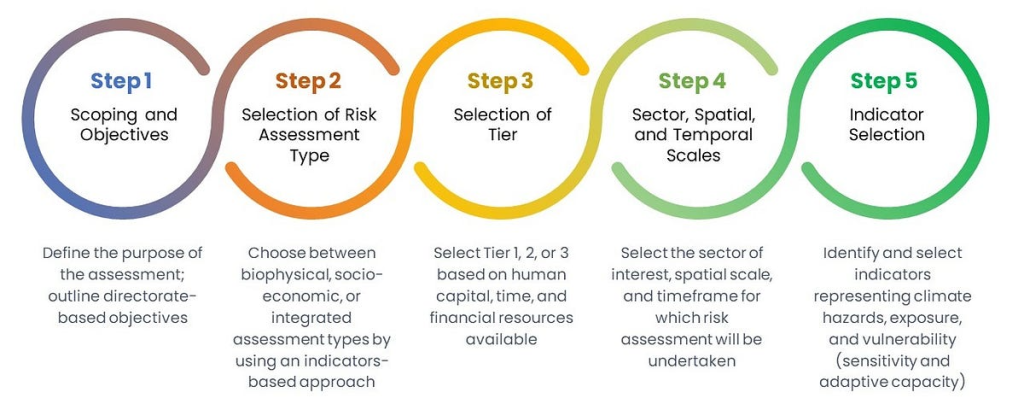
Structure of the group activity
These activities not only surfaced meaningful regional distinctions in how officers perceive climate risks but also helped break the monotony of technical presentations and information-heavy sessions. By encouraging participants to actively recall and apply the content shared earlier, the activities fostered deeper engagement aimed at improving the assimilation of key concepts. In doing so, participants could connect abstract frameworks to field realities in a practical and relevant manner.
Our next blog will build on these insights to explore how officers translated this understanding into sector-specific risks, offering a closer look at the diverse ways climate impacts are experienced — and addressed — across Odisha.
Lakshmi Menon is a Senior Analyst and Tashina Madappa Cheranda is a Senior Associate in the Climate, Environment & Sustainability sector at the Center for Study of Science, Technology and Policy (CSTEP), a research-based think tank.
More About Publication |
|
|---|---|
| Date | 11 June 2025 |
| Contributors | |
| Publisher | CSTEP |
| Related Areas | |
Get in touch with us at
cpe@cstep.in