


India’s power sector has been witnessing a large share of renewable energy (RE) being integrated into the grid. This is expected to grow at a high pace in the future as well. With increasing RE share, storage, especially pumped-hydro energy storage (PHES), plays a key role in dispatching the energy from RE resources, peak load shaving, frequency regulation, voltage support, providing round-the-clock support, and balancing the grid, among others. Over the years, PHES has been one of the leading bulk energy storage options worldwide due to its ability to provide support in grid handling.
This blog post provides an overview of PHES in the Indian context, detailing the current status and prospects for future development.
The reassessment studies carried out by the Central Electricity Authority (CEA) in 1987 identified around 63 potential sites that were economically viable for PHES. A probable capacity of 96,529.6 MW had been assessed across regions. The Western regions of India
have a higher potential of 41% due to favourable topography. The Southern and NorthEastern regions (both with a potential of around 18%) are followed by the Northern region (14%) and the Eastern region (9%). Subsequently, detailed surveys and investigations had to be carried out to understand the environmental impacts, and land acquisition and resettlement issues from these potential sites.
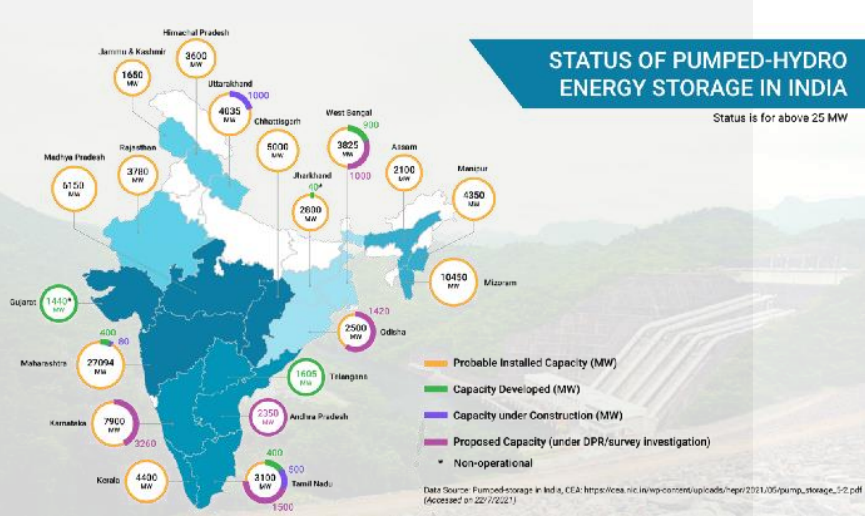
Though India has tremendous potential for PHES, only six plants with a total of 3305.06 MW are currently under operational capacity in four states. However, of these, three plants with a cumulative capacity of 1480 MW are currently not operational in pumping mode due to the
following issues:
– Kadana project in Gujarat with an installed capacity of 240 MW is presently not operational in pumping mode due to vibration in the machines. Testing has been ongoing, and the anticipated commissioning dates have not yet been disclosed.
– Another project in Gujarat, Sardar Sarovar, with an installed capacity of 1200 MW has also been delayed since 1961; recent status shows construction of the tail pool dam is complete. Discussions are ongoing for operationalising the plant in pumping mode.
– Similarly, operations at Panchet Hill in Jharkhand with 40MW installed capacity have been delayed due to issues with land acquisition for construction of the tail pool dam.
Around 1590 MW of installed capacity is under construction — namely, Tehri with 1000 MW in Uttarakhand, Kundah with 500MW in Tamil Nadu, and Koyna Left Bank in Maharashtra with 80 MW capacity. All the three projects are expected to be commissioned during 2022–2026. Further, many states have initiated PHES surveys and investigations. Currently, 19 plants of cumulative installed capacity of 9780 MW across five states are in different stages, such as pre-feasibility studies, survey and investigation, preparation of detailed project report (DPR), and examination of proposed projects under CEA.
Most PHES projects that are operational or under construction have been delayed due to various factors — from environmental clearance to land acquisitions — making the project in question economically unviable in terms of time and overrun of the total project cost. There
is a need to boost the entire process, from planning to development, with prompt clearance in a time-bound manner to derive the maximum potential benefits from PHES.
In our previous blog in the Measuring the Microns series, we briefly...

In this blog series titled Measuring the Microns, we examine why greater...

India’s transition to a cleaner power system has moved from a supply...

In the first blog in ‘The AI shift’ series, we examined what...
With growing electricity demand, renewable energy penetration, and storage requirements, Indian distribution...

In the first blog in ‘The AI shift’ series, we looked into...