


Risk, in the context of climate change, is a function of three factors — hazards, exposure, and vulnerability. Global practitioners carry out either hazard mapping or vulnerability assessments and often term the outputs of these assessments as ‘risk’, which does not align with the Intergovernmental Panel on Climate Change (IPCC) definition of risk (IPCC 2020). The two forms of assessments provide complementary results, and when integrated, they signify risk — highlighted in the first of this blog series. Another aspect emphasised in the previous blog was the absence of accounting for sectoral interdependencies in climate risk assessments. This piece will shed light on what sectoral interdependencies are, the need for incorporating them in risk characterisation, and the ways in which they can be incorporated.
Sectoral interdependency, in the context of climate change risk, encompasses several dimensions and can be broadly classified as: functional, physical, geographical, institutional, and policy-related, financial, social, and cyber. This interdependency is further determined by spatial and temporal scale, socioeconomic context, magnitude, the complexity of interaction, and the ability to adapt.
For example, Cyclone Tauktae, which hit India in May 2021 and left a trail of destruction in Kerala, Karnataka, Maharashtra, Gujarat, and Goa, not only claimed lives, but also affected the food market, as it led to: a) crop failure or/and loss, b) disruption in energy supply due to damage to enegy infrastructure, and c) disturbed transport network (rail and road). With such natural disasters, lower crop productivity and crop failure will directly impact food supply, while damage to energy infrastructure leading to an outage at storage and processing facilities will further exacerbate this, and finally, disruption of road or railway services will hamper freight transporting foodgrains to markets, impacting the food supply (more elaborately depicted in Figure 1).
This is a clear demonstration of interdependencies resulting in cascading impacts, with effects of one extreme event creating chokepoints along the value chain — in this case, food supply. This makes a case for identifying indicators pertaining to multiple factors along the value chain, rather than looking at individual systems, leading to gross underestimation of the risk to food supply.
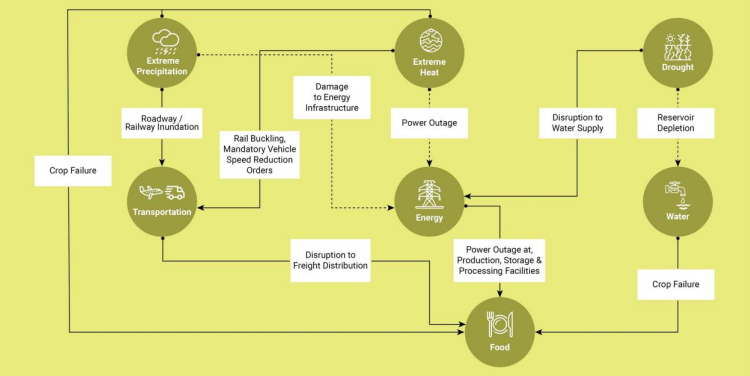
Figure 1. Infographic showing the interaction of the food sector with transport, energy, and water sectors (Source: C40 Knowledge Hub, accessible at: How to address infrastructure interdependencies when adapting to climate change (c40knowledgehub.org))
Typically, a risk assessment provides answers to: a) what could go wrong, b) the likelihood of it going wrong, and c) who or what will be most at risk. It usually focuses on an individual sector; however, sectors do not operate in silos and are interdependent. Therefore, a risk assessment that does not consider these interdependencies would lead to gross underestimation of risk, and result in missed opportunities for adaptation, or even maladaptation, as there are synergies as well as trade-offs in adaptation.
The above example of Tauktae affecting food markets highlights the role of transport as well as electricity infrastructure in the market price rise of food. If, while assessing the risk to food markets and suggesting adaptation strategies, practitioners only concentrate on crop failure or/and losses, without factoring the other two sectors at play (transport and electricity), it could result in strengthening one sector over another, leading to missed opportunities for adaptation or maladaptation.
Mapping of sectoral interdependencies demands the participation of a wide range of public and private stakeholders. Armed with this understanding, hazards could bemapped, considering impacts on different sectors, their components, and interdependencies. The selection of indicators to represent these interdependencies in vulnerability assessment — a component of climate risk — is the next logical step
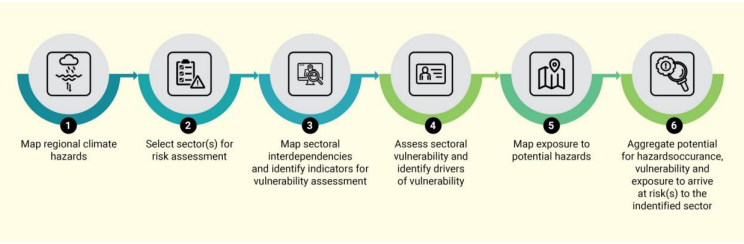
Although much of the planning and implementation in India happens at a sectoral level, climate risks and their impacts are cross-sectoral, highlighting the need to transition from sectoral focus to development that recognises interdependencies. The utility of risk assessments that incorporate interdependencies is information that can drive action synergistically, with the goal of building long-term resilience in systems and communities.
The authors work in the area of Adaptation and Risk Analysis at CSTEP.

In our previous blog in the Measuring the Microns series, we briefly...

In this blog series titled Measuring the Microns, we examine why greater...

India’s transition to a cleaner power system has moved from a supply...

In the first blog in ‘The AI shift’ series, we examined what...
With growing electricity demand, renewable energy penetration, and storage requirements, Indian distribution...

In the first blog in ‘The AI shift’ series, we looked into...