


Air doesn’t care about man-made boundaries. Our responses to managing air quality, therefore, must organise around this fact.
The National Clean Air Programme (NCAP), launched in 2019, marked a decisive shift in India’s approach to air quality. For the first time, the country set explicit pollution reduction targets for 131 non-attainment cities, tied funding to performance, and established monitoring as an essential part of the process. Air quality was no longer just an environmental aspiration; it became a measurable governance outcome.
Yet a structural challenge remains. Pollution does not stop at administrative boundaries. It can travel across regions, linking distant sources to faraway impacts. The Indo-Gangetic plain (IGP), home to hundreds of millions of people, is an example, as it functions as a single, interconnected pollution basin. For example, emissions from different sources such as residences, industry, and stubble burning from outside Delhi settle as particulate matter over Delhi. Managing this through city-level action plans alone is like treating a systemic illness one symptom at a time.
This is where airshed-based management offers a more coherent approach. The concept is not new globally. Instead of managing air quality within administrative boundaries, it looks at shared atmospheric regions and the movement of pollution across them. In India, the institutional foundations built under NCAP, combined with an expanding monitoring network, have quietly created the conditions for the country to take this next step.
CSTEP has not just been a quiet observer of this shift. Through our research—ranging from creating scientific clean air action plans to developing models that enable more informed policy decisions—we have been contributing to and shaping this conversation.
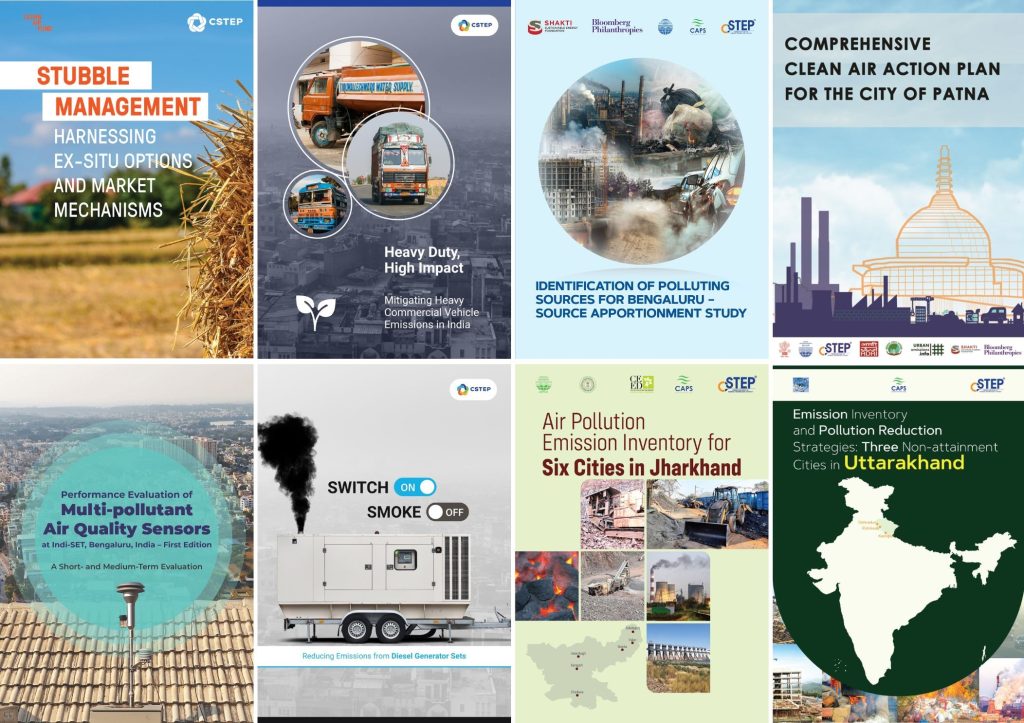
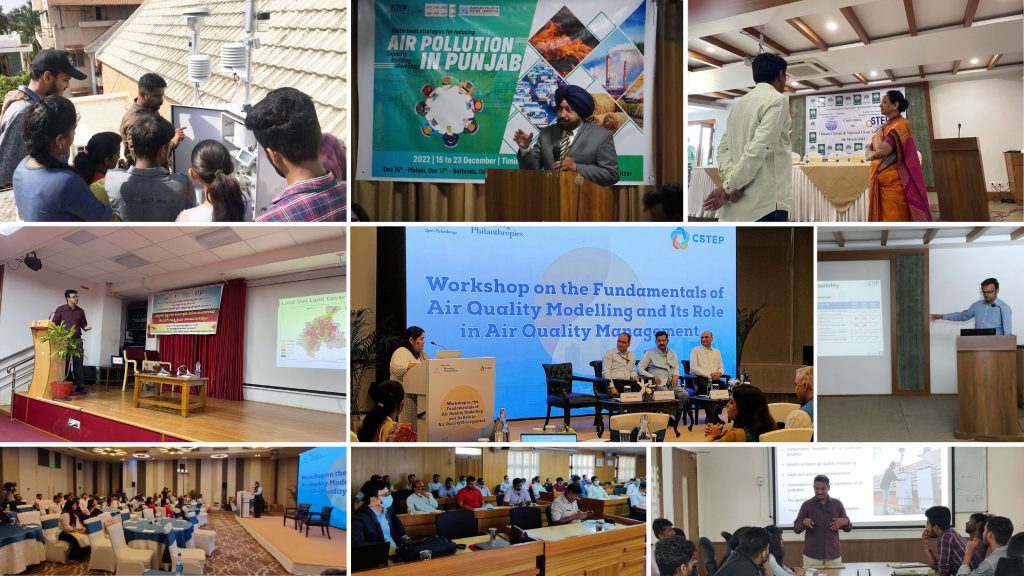
The India Clean Air Summit (ICAS) was conceptualised in 2019–20 with a simple purpose: to ensure that research on air quality (by us and others) didn’t remain confined to desks, bookshelves, dedicated project web pages, or individual and institutional knowledge. The summit created a platform for these research findings to reach academic and policy circles and the growing community of practitioners working on air quality management.
ICAS has since evolved into a premier annual platform for evidence-based knowledge sharing and dialogue on the latest scientific research on air quality management in the Indian context. Each edition has reflected where the country’s clean air conversation stood, and needed to go, at that moment in time.
CSTEP’s work on air quality and ICAS were conceived around the same time as NCAP—when India was beginning its first comprehensive national effort to tackle air pollution. Over the years, the themes and topics chosen for discussion at the summit have closely tracked the challenges emerging from this evolving policy and implementation landscape. In turn, the knowledge sharing that occurs at the summit has helped shape research, inform policy decisions, and expand our understanding of both theory and practice of air quality management.
The three-day summit (19–21 August 2026) is structured to move participants from technical grounding to policy dialogue to action.
Day 1 (19 August) sets the stage by building a strong technical understanding. Three technical training sessions run through the day: one on the use of air quality modelling tools for local- to regional-scale air quality management, second on India’s air quality law and policy landscape, and the third on Advanced Aerosol Chemical Speciation Monitor (ACSM) data analysis.
Day 2 (20 August) is where the summit gathers momentum, opening with welcome and keynote addresses and a panel discussion focusing on air quality management at the regional level. Sessions will also explore the importance of an open-source national emission inventory for policy and mitigation measures; cleaning up industrial emissions with a focus on micro, small, and medium enterprises and markets; and techno-economic assessment methods to prioritise air quality interventions.
Day 2 also features the AIRLAB Microsensors Challenge (AMC)—an international benchmarking initiative launched by AIRLAB in 2018. As the scientific partner for AMC’s fifth edition, CSTEP evaluated sensor nodes from 18 different manufacturers at its India Air Quality Sensor Evaluation and Training (Indi-SET) facility in Bengaluru.
Day 3 (21 August) broadens the conversation by including a plenary panel discussing corporate perspectives on air pollution mitigation, followed by a session on air quality management in cities through the lens of unique challenges and opportunities. The afternoon turns to accountability, with a session assessing policy efficacy, before closing with a panel on community participation for clean air.
CSTEP will also be launching four reports based on our latest studies. These studies explore mitigation of air pollution across the IGP, a governance framework for managing air pollution across South India, climate co-benefits of black carbon mitigation in the IGP, and addressing transport sector emissions in Punjab.
Across all three days, attendees can expect a range of discussions focused on moving from city- to regional-scale management, report launches, and live demonstrations of modelling tools designed for decision-makers and practitioners.
More details about the summit can be found here
NCAP, as part of its initial phase, has built a strong city-level foundation over the past decade; however, India’s air quality challenge has outgrown city-level solutions. The next phase of air quality management in India requires coordinated action across jurisdictions, sectors, and institutions, with airshed-based approaches providing the framework for that coordination. This is what the conversations at ICAS 2026 will focus on.
Join us to be a part of the discussions.
In our previous blog in the Measuring the Microns series, we briefly...
In this blog series titled Measuring the Microns, we examine why greater...
India’s transition to a cleaner power system has moved from a supply...

In the first blog in ‘The AI shift’ series, we examined what...
With growing electricity demand, renewable energy penetration, and storage requirements, Indian distribution...

In the first blog in ‘The AI shift’ series, we looked into...