Andhra Pradesh Eastern Power Distribution Company Limited’s (APEPDCL) peak demand is projected to more than double by 2040, from about 4.8 GW in FY 2023–24 to nearly 11 GW by FY 2039–40. This study asks how the distribution company (DISCOM) can meet that growth reliably and at the lowest cost. The answer is a power mix built on solar and energy storage.
India’s national framework requires DISCOMs to prepare tailored, 10-year long-term demand and resource adequacy plans. Andhra Pradesh APERC (Framework for Resource Adequacy) Regulation, 2026 puts this into practice, requiring annual planning across demand forecasting, generation, storage procurement, and compliance. This study provides APEPDCL a detailed, evidence-based starting point for that long-term planning.
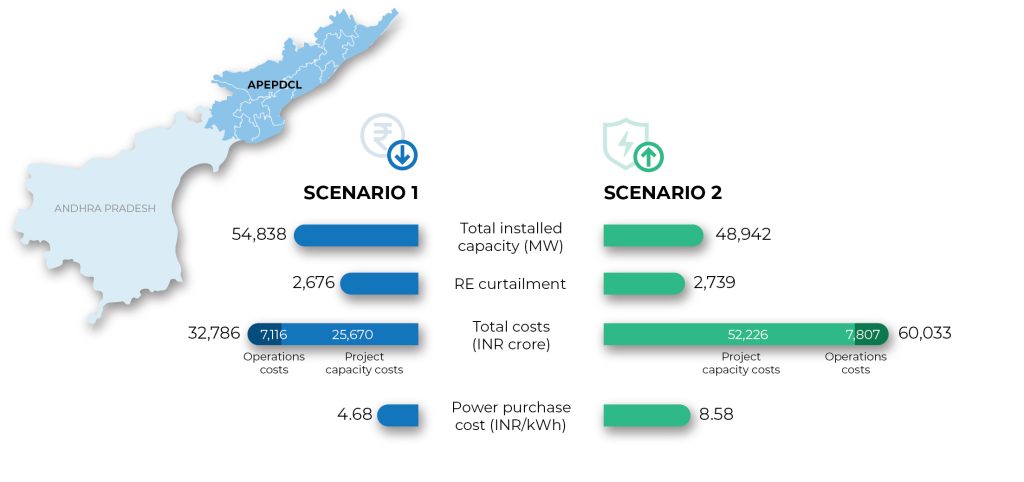
We modelled two pathways to FY 2039–40 using least-cost capacity expansion and hourly dispatch analysis under high renewable energy penetration. In the first, APEPDCL plans from its existing capacity and adds new resources through least-cost optimisation. In the second, it also takes on 36.2% of the capacity additions that the Central Electricity Authority’s national plan envisages for Andhra Pradesh.
The least-cost pathway brings the average power purchase cost down to INR 4.68/kWh, from INR 5.77/kWh at present. With planned additions, including more coal, the cost rises to INR 8.58/kWh. The cheaper pathway, however, has slightly higher unserved energy, so there is a trade-off between cost and reliability.
The study finds that APEPDCL needs a mix of storage technologies, not a single one. Battery energy storage systems (BESS) provide fast response and evening peak support, while pumped hydro delivers long-duration, overnight discharge. Where feasible, combining the two works better than either alone.
Where storage is placed is also important. Co-located BESS with renewable energy plants can improve renewable energy utilisation, reduce curtailment, and support evening and non-solar-hour demand. Distribution-level BESS can help manage the growth of distributed renewable energy. BESS near thermal plants can support thermal fleet flexibility.
More about publication |
|
|---|---|
| Date | 5 October 2026 |
| Type | Reports |
| Contributors | |
| Publisher | CSTEP |
| Related areas | |
| Pages | 62 |
Get in touch with us at
cpe@cstep.in