
Recent tensions in West Asia have highlighted a key vulnerability in India’s fertiliser sector. India does not lack urea production capacity. What it lacks is control over the feedstock that powers it. Every spike in global gas prices reverberates through the farm economy.
India imported close to 27% of its urea needs and over 80% of the natural gas used for fertiliser production in 2025. When gas supplies tighten and costs rise, the government absorbs the shock through subsidies. In 2024–25 alone, the fertiliser subsidy bill crossed INR 1.71 lakh crore. This is not a one-time challenge but a structural weakness. The challenge lies at the heart of the production chain. Urea production depends on ammonia, and ammonia production depends on natural gas. Gas serves as both feedstock and fuel. As a result, disruptions in the Gulf can affect fertiliser economics in India within weeks. Farmers ultimately bear the consequences, whether through supply constraints or the fiscal burden of rising subsidy requirements. Addressing this challenge requires more than short-term measures; it requires rethinking how fertiliser is produced.
Creating that linkage will require coordinated action. States can identify suitable maize-growing regions for cluster development. Farmer producer organisations, self-help groups, and cooperatives can support aggregation and implementation. Standards for low-carbon urea can help create market signals and stimulate demand. Financing can draw on public support, private investment, green bonds, and carbon revenues to improve project economics and attract capital.
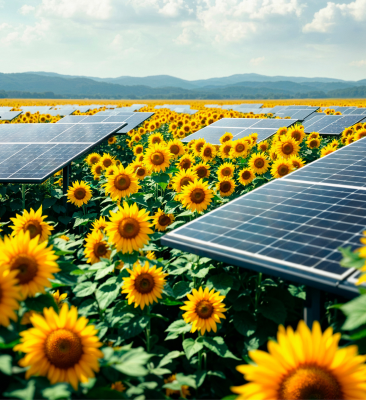
India has relied on imports and subsidies to secure fertiliser supplies, but this approach remains vulnerable to global price and supply shocks. Integrating agrivoltaics, bioethanol, and urea production offers a pathway towards Atmanirbharta in fertiliser production—one that begins not with imports but with resources already rooted in India’s fields.
Click here to read more
More about publication |
|
|---|---|
| Date | 02 July 2026 |
| Type | Op-eds/Interviews/Press Releases |
| Contributors | |
| Publisher | PV Magazine |
| Related areas | |
Get in touch with us at
cpe@cstep.in