
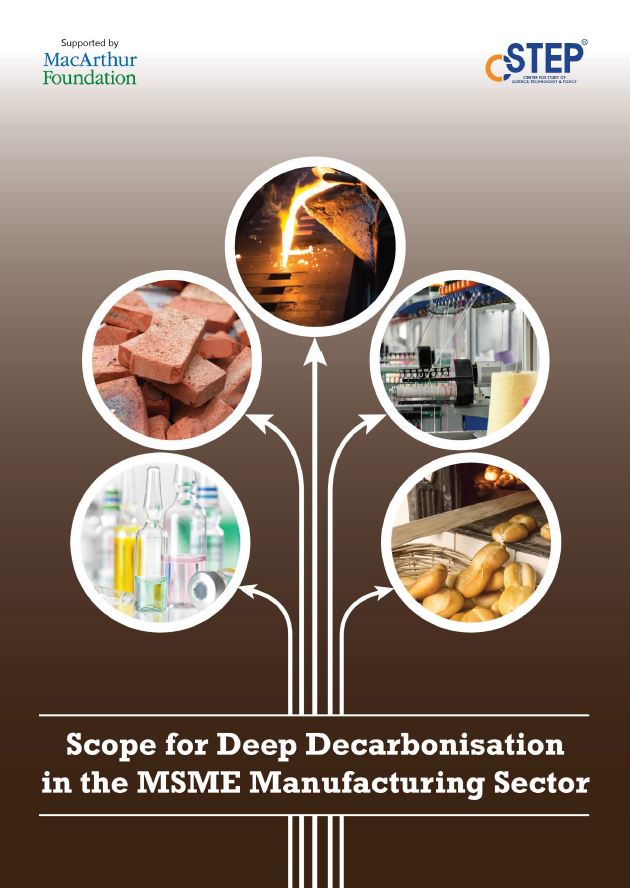
The Micro, Small and Medium Enterprise (MSME) industries are still majorly dependent on fossil fuels for their energy requirements, making them particularly susceptible to increasing fuel prices. With energy costs having a substantial share in the overall manufacturing costs, the need for sustainable alternatives is crucial. Decarbonisation of MSMEs is necessary to reduce fossil fuel dependency in the industrial sector.
CSTEP conducted a scoping study to assess the potential for deep decarbonisation in the MSME manufacturing sectors. The study estimated the potential for mitigating GHG emissions and analysed the techno-economic feasibility of decarbonisation technologies. Seven energy- and emission-intensive MSME manufacturing clusters were selected across India.
The implementation of a combination of the recommended Energy Efficiency (EE) measures, Renewable Energy (RE) solutions, and Advanced Technologies showed potential savings in emissions of 1,36,581 tCO₂, energy usage of 3,85,383 GJ, and energy costs of INR 37 crore. It is important to note that while all clusters experienced decreased energy costs, an exception was found in Asansol.
The findings of this study have been documented as seven cluster-wise reports, one policy brief, and a full-length report.
Cluster reports:
MSME cluster_Tiruppur, MSME cluster_Ludhiana, MSME cluster_Delhi, MSME cluster_Coimbatore, MSME cluster_Bengaluru, MSME cluster_Asansol, MSME cluster_Alathur
More about publication |
|
|---|---|
| Date | 28 June 2024 |
| Type | Reports |
| Contributors | |
| Publisher | CSTEP |
| Related areas | |
| Page Count | 97 |
| Copyright | CSTEP |
Get in touch with us at
cpe@cstep.in